
Investment Rating:
BUY (High-Conviction Value Opportunity)
The Verdict:
A world-class consumer defensive giant is being offered at a rare discount due to temporary integration friction and accounting anomalies.
Current Market View:
The market is deeply skeptical, pricing Clorox like a decaying legacy business rather than a highly resilient defensive moat.
Valuation Framework:
15-17x normalized Owner Earnings.
Fair Value & Investment Range
| Metric | Estimate |
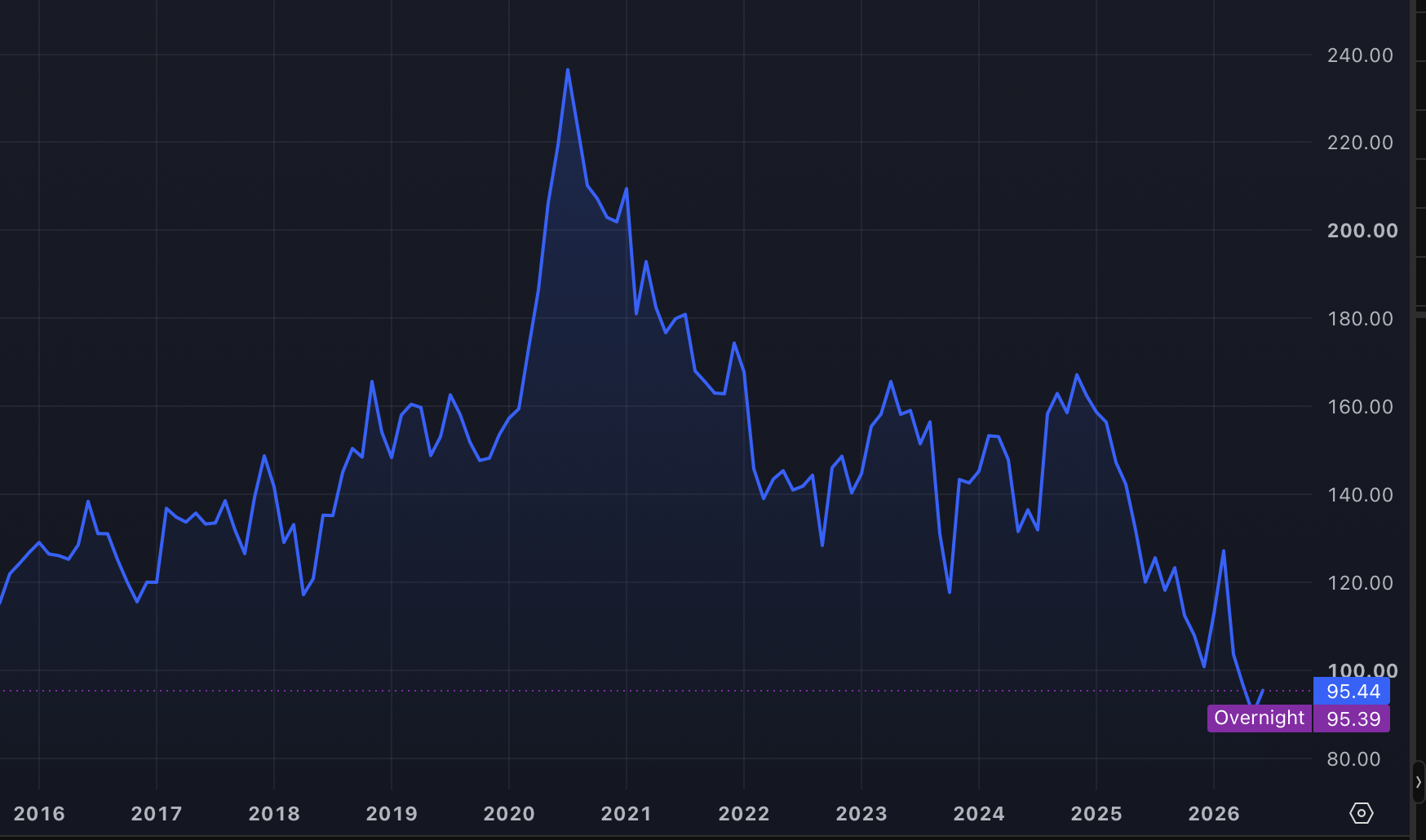
| Current Share Price | ~ $95.44 |
| Current P/E Multiple | ~ 15.47x |
| My Fair Value Range | $98 – $112/share |
| Attractive Buy Zone | $85 – $95/share |
| High-Conviction Opportunity | Below $85/share |
| Valuation Framework | 15-17x normalized Owner Earnings |
| Margin of Safety Needed | 15-20% discount to Fair Value |
Note: The Fair Value Range mathematically aligns with the mid-cycle base case scenario detailed below.
Investment View
The question is not whether Clorox is a high-quality business — the question is whether the current price offers an equity coupon rate high enough to satisfy a disciplined value investor. At $95.44 per share, we believe the market is handing long-term investors a remarkably rare opportunity to buy a legendary consumer defensive franchise at an uncharacteristic bargain.
A series of short-term challenges has temporarily clouded Clorox’s true cash generation. An expensive ERP software implementation, leadership transitions, and the integration of GOJO Industries have combined to spark a Wall Street exit. This panic has compressed the forward valuation multiple to a highly attractive level, making it one of the most compelling risk-reward setups in the consumer staples space today.
The current price implies a 6.9% Owner Earnings yield and hands investors a generous 5.2% dividend yield to wait out the integration process. This is a business built on extreme pricing power and near-unbreakable brand loyalty. For the value investor who can look past quarterly earnings noise, the downside here is highly insulated.
Fair Value Uncertainty
Fair Value Uncertainty: Medium
The uncertainty is not primarily about:
- Business durability: Clorox’s bleach, disinfecting wipes, and household essentials are deeply ingrained habits that consumers do not easily abandon.
- Competitive position: The company holds dominant number-one or number-two market share spots in over 80% of its product categories.
- Revenue stability: Total sales remain highly predictable and acyclical, as cleaning habits do not fluctuate with GDP.
The main variables are:
- GOJO Integration Efficiency: The speed at which Clorox can harvest synergies and optimize the supply chain of its newly acquired commercial hygiene business.
- ERP Software Stabilization: Resolving the temporary inventory drawdowns and operational hiccups related to its enterprise resource planning system transition.
- Commodity Cost Inflation: Staying ahead of sudden swings in plastic packaging and transport logistics, which are heavily tied to global oil prices.
Investor Watch Point
The key catalyst to watch over the next 12 months is the stabilization of organic sales growth and gross margin recovery to the historical 44-45% baseline. If Clorox can successfully complete its CEO search, fully integrate GOJO without further impairment charges, and resolve its ERP inventory bottlenecks, the market will rapidly re-rate the stock back toward its premium historical multiple.
Investment Snapshot
| Metric | Current View |
| Company | The Clorox Company (CLX) |
| Business Description | Global manufacturer and marketer of consumer and professional cleaning and household products. |
| Market Cap | ~ $11.54 billion |
| Current Share Price | ~ $95.44 |
| Current P/E | 15.47x |
| Forward P/E | 15.82x |
| P/Owner Earnings (P/FCF) | 14.43x |
| Owner Earnings Yield | 6.93% |
| Dividend Yield | 5.20% |
| IV Rank | 69.5% |
| Implied Volatility | 86.0% |
| Wall Street Consensus Target | $104.58 (Sentiment: Neutral to Bearish) |
| Value Investor Target Multiple | 15-17x Owner Earnings |
| Initial Buy Zone | $85 – $95/share |
Note: Treat the Wall Street Consensus Target row as a contrarian sentiment check. High volume of Neutral/Bearish sentiment on Wall Street often signals our ideal buy window for quality compounders.
Investment Thesis
The Clorox Company came across my radar because a classic “screener illusion” has disguised its true fundamental health. Mainstream financial databases show a massive collapse in trailing free cash flow down to $380 million, making the stock look expensive and capital-constrained.
However, this metric is heavily distorted by a single $634 million temporary working capital outflow in Q3 2026 as the company aggressively drew down accounts payable during its ERP transition. When you strip away these transient balance sheet distortions and calculate true normalized Owner Earnings, you discover that the core machine is actually pumping out $800 million in highly predictable annual cash.
While short-term analysts focus on the immediate margin headwind of the GOJO acquisition and leadership changes, they are completely ignoring the immense long-term pricing power of Clorox’s core brands. A long-term value investor should care right now because we are getting an elite compounder at a double-digit discount to its intrinsic worth, accompanied by a massive 5.2% dividend yield that is fully supported by normalized cash flows.
Business Quality: The Pricing Power of Household Moats
Clorox is a masterclass in the psychology of consumer defensive moats. The beauty of the business is its absolute simplicity. The core cleaning, bleach, and charcoal products are simple, chemically straightforward, and structurally guaranteed to remain relevant for generations.
The company’s economic moat is built on intense customer switching costs and a massive trust premium. When a consumer is buying a product designed to disinfect their home or prevent illness, they will not risk an unbranded alternative to save fifty cents. This psychological dominance allows Clorox to push through consistent pricing increases even during highly inflationary economic periods.
Furthermore, Clorox operates a highly capital-light business model. Because it does not require massive physical capital reinvestment to grow its distribution network, it has historically generated exceptional Return on Invested Capital (ROIC). This capital-light blueprint allows the majority of operating profits to bypass capital expenditures and flow directly into shareholder dividends and buybacks.
Financial Strength: The Good
Revenue Growth
Despite intense macroeconomic crosswinds, Clorox’s underlying top-line stability remains remarkably consistent. While organic sales dipped roughly 9% in fiscal 2026 due to the deliberate ERP-related inventory transition, total revenues have consistently hovered around the $6.7 billion annualized mark. Contract predictability is exceptionally high, and long-term volume demand remains firmly anchored.
Free Cash Flow & Owner Earnings Machine
To find the true, undistorted cash output of Clorox, we use the Owner Earnings formula. This calculation isolates actual operational earnings and strips away the aggressive working capital swings that skew standard free cash flow metrics:
Owner Earnings = Net Income + Depreciation & Amortization – Average Capital Expenditures
The table below tracks the true cash output of the business over the last four reported quarters:
| Quarter | Free Cash Flow (or Net Income + D&A – CapEx) |
| Q3 2026 | $206.00 million |
| Q2 2026 | $174.00 million |
| Q1 2026 | $102.00 million |
| Q4 2025 | $318.00 million |
The company generated approximately: $800.00 million in trailing annualized Owner Earnings.
This matches a healthy 12% normalized Owner Earnings margin. This robust cash conversion proves that Clorox’s underlying capital intensity remains very low, requiring only about $190 million in annual maintenance capital expenditures to run its global operations.
Balance Sheet: The Strength / Weakness
| Metric | Amount |
| Cash | ~ $1,187.00 million |
| Total Debt | ~ $4,486.00 million |
| Net Debt | ~ $3,299.00 million |
| Debt/EBITDA | 3.44x |
| Net Debt/Owner Earnings | 4.12x |
The balance sheet currently carries higher leverage than historical norms, largely due to the acquisition of GOJO Industries and short-term debt issued during the ERP transition. A Net Debt to EBITDA ratio of 2.53x is highly manageable for a consumer defensive business with incredibly visible, utility-like cash flows.
Additionally, the optical “negative book value” of negative $67 million on the balance sheet is an accounting distortion caused by years of aggressive, highly successful share repurchases, rather than actual balance sheet distress. With cash reserves sitting at a comfortable $1.18 billion, Clorox possesses plenty of liquidity to comfortably navigate its debt maturity schedule.
Valuation: The Main Problem / Opportunity
| Metric | Multiple |
| P/E Ratio | 15.47x |
| Forward P/E | 15.82x |
| Price / Owner Earnings | 14.43x |
| EV / EBITDA | 11.64x |
The market is pricing Clorox with extreme pessimism, ignoring its historical trading premium. Historically, Clorox has commanded an average P/E multiple of 22-24x. Today, you can acquire this high-quality defensive moat at just 14.4x Price to Owner Earnings.
Wall Street’s consensus price target of $104.58 is a classic lagging indicator. Career-conscious professional analysts have aggressively trimmed their ratings to “Reduce” and “Hold” just as the valuation has reached its most attractive entry point in years. They are treating temporary integration costs as a permanent impairment of Clorox’s core earning power.
What Is The Company Worth?
We evaluate Clorox’s valuation through the lens of a coupon-paying equity bond.
Scenario 1: Premium Quality Business (Optimistic Base)
- Assumptions: Clorox resolves the ERP software transition issues by early 2027, achieves major cost synergies with GOJO, and organic revenue growth returns to a stable 3-4% long-term trajectory. Gross margins expand back to 45%.
- Estimated Fair Value: $118 – $131/share
- Explanation: The market rewards this return to steady cash generation by re-rating the stock to a historical defensive premium of 18-20x Owner Earnings.
Scenario 2: Attractive Entry (Conservative / Mid-Cycle)
- Assumptions: Organic growth remains flat at 1-2%, the GOJO integration faces minor ongoing integration delays, and gross margins remain steady at 43%.
- Estimated Fair Value: $98 – $112/share
- Explanation: This conservative mid-cycle multiple of 15-17x Owner Earnings reflects a highly defensive cash machine growing at a modest, stable pace.
Scenario 3: Value Investor Opportunity (Pessimistic / Cyclical Bottom)
- Assumptions: Persistent inventory headwinds, flat organic volume growth, and prolonged inflation in petrochemical packaging compress margins.
- Estimated Fair Value: $79 – $92/share
- Explanation: Multiple compresses to a rock-bottom 12-14x Owner Earnings. The stock’s downside is highly protected at this level as the dividend yield would exceed 6.3%, inviting massive institutional value-buying.
What Price Would Interest Me?
Watch Zone:
$112/share
At this price, the implied Owner Earnings yield drops to 5.9%, and the multiple expands to 17x. This price represents a fair valuation, offering solid, utility-like returns but providing very little margin of safety.
Attractive Buy Zone:
$85 – $95/share
This is our current target window. At $95.44, the stock sits right at the entry threshold of this zone, providing a safe 15% discount to conservative fair value, an impressive 6.9% Owner Earnings yield, and a rock-solid 5.2% dividend yield.
Exceptional Opportunity:
Below $85/share
A price below $85 represents a screaming buy. The margin of safety expands to over 25%, and the risk of permanent capital loss becomes extremely remote given the immense, untouchable brand equity of the underlying assets.
Additional Metrics Investors Should Watch
- Owner Earnings Growth: Sequential stabilization of cash collections as the accounts payable distortion rolls off.
- Return on Invested Capital (ROIC): Rebounding back above the historical double-digit threshold once the capital-light nature of the core operations resumes.
- Capital Allocation (Buyback Yield): Dilution reduction and buyback discipline once short-term debt is systematically paid down.
- Contract/Subscription Health: Retention rates in the B2B professional cleaning division post-GOJO merger.
Risks
- Valuation Risk: If interest rates remain structurally higher for longer, yield-sensitive consumer defensive stocks like Clorox could experience prolonged multiple compression as bond yields compete for capital.
- Business/Moat Risk: Intense competition from private label brands during times of consumer pocketbook stress could limit Clorox’s ability to easily pass on future price hikes.
- Capital Allocation Risk: If management continues to pursue large, debt-fueled acquisitions instead of paying down debt and repurchasing undervalued shares, it could permanently degrade the company’s return profile.
Final Takeaway
The Clorox Company is the type of company a long-term investor would love to own.
The business has:
- [X] Competitive advantages (Dominant brand equity, massive scale, and immense pricing power)
- [X] Strong cash generation (Highly predictable, recurring Owner Earnings)
- [X] Durable business model (Simple, essential products with exceptionally high brand loyalty)
- [X] Attractive industry position (Highly consolidated consumer staples market with stable dynamics)
But today’s valuation determines whether it is a good investment.
A great company does not always make a great investment at any price.
The opportunity comes when the market offers a price that provides an adequate margin of safety.
Fair value estimate based on normalized earnings multiples, Owner Earnings analysis, and margin-of-safety principles. This is not a recommendation to buy or sell securities.