

Status: Position Closed (95.18% Annualized Return)
On February 5th, I launched my MRVL PMCC Master Battle Plan. The strategy was built on a foundation of capital efficiency: using deep In-The-Money (ITM) LEAPs to maintain bullish exposure while systematically harvesting premium through shorter-term “rent” calls.
Today, I hit the eject button. This trade didn’t end because of a time limit; it ended because the strategy reached its mathematical peak. Here is how I managed a 21% vertical spike to walk away with a nearly 100% annualized return.
The Execution: Building the Base
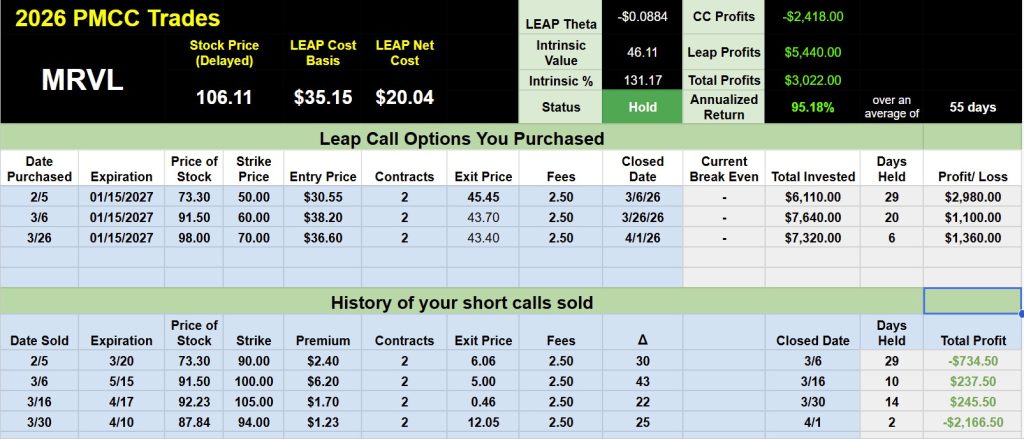
Since February, I’ve been cycling through Marvell with a disciplined approach to the Poor Man’s Covered Call (PMCC). By following my protocol—closing or rolling short calls early to avoid assignment—I banked $2,980 in my first cycle and $1,100 in the second.
The Final Entry: On March 26th, the technicals flashed a “go” signal. The David Landry Bowtie moving averages (10, 20, and 30-day) converged at $86—a classic squeeze. I reset the board:
- Long Leg: 2× Jan 15, 2027 $70 Calls @ $36.60
- Short Leg: 2× April 10, 2026 $94 Calls @ $1.23 (Sold March 30)
- Stock Price at Squeeze: $87.84
I was the “Predator,” positioned for a breakout while collecting quiet rent on a 0.25 delta short call.
The Catalyst: The Nvidia “Teleport”
Market news can move faster than any spread can adjust. On March 31st, Nvidia’s $2 billion investment in Marvell sent the stock vertical. In just 48 hours, MRVL blew past my $94 strike and peaked near $106.11.
Suddenly, the trade was in a “Success Trap.” My short leg delta spiked to 0.89, while my long LEAP delta sat at 0.84.
The Math Problem: I was now “Delta Negative.” Because the short calls were deeper ITM than the LEAPs, every dollar MRVL gained from $106 was actually reducing my account value. My “rent” calls had become a ceiling that was suffocating the gains of my $70 LEAPs.
The Decision: Roll for a Debit or Walk Away?
By the morning of April 1st, I had a choice. I could roll the $94 strike out to May at a $110 strike for a $7.55 debit per share.
But my Golden Rules are clear: Monitor Extrinsic Value, not individual leg P/L.
- The Roll: Paying $1,510 to “save” the trade would spike my cost basis and significantly increase my risk if MRVL saw a mean reversion.
- The Technicals: My Stochastic RSI was at 69.47. While the trend was strong, the stock was massively overextended from its moving averages.
I refused to pay a heavy debit to “stay in the game.” I followed the playbook: Close the diagonal package to preserve the LEAP’s realized value.
The Result: $3,022 in Realized Profit
At 10:19 AM, I liquidated the entire position. Even though the short leg showed a loss of $2,166.50 due to the extreme move, the $70 LEAPs did exactly what they were supposed to do, banking a $1,360 profit in just 6 days during this final leg.
The Total Campaign Numbers:
- Total Realized Profits: $3,022.00
- Annualized Return: 95.18%
- Days Active: 55
The Roadmap Forward
I am now 100% in cash on MRVL, waiting for the technicals to reset. Trading isn’t about being “right” on the stock’s direction forever; it’s about knowing when the math of your specific strategy has been exhausted.
The Re-Entry Signal:
- Stochastic RSI Reset: I’m sidelined until the Full K line cycles back down to the 20 level.
- Moving Average Touch: I’m waiting for a price retracement to the 20-day EMA.
When the fever of the Nvidia news cools and the “Bowtie” converges again, I’ll be back. For now, the profit is locked in.
Live to trade another High Noon.