How I Learned to Stop Worrying and Love the Garden
My internet has been completely dead for 5 days after a month of playing “now you see me, now you don’t.” When Brightspeed first brought symmetrical fiber to my rural neck of the woods, I was thrilled. Finally, an escape from 20 years of Spectrum’s annual “because we can” price hikes! It was beautiful while it lasted.
Then reality hit. Between a severely understaffed offshore call center and a total lack of local communication—perfectly illustrated when their trenching crew eagerly sliced right through my existing cable line—the operational wheels completely fell off.
I’ve been reading up on their financial situation, and it is a beautifully executed masterclass in modern capitalism:
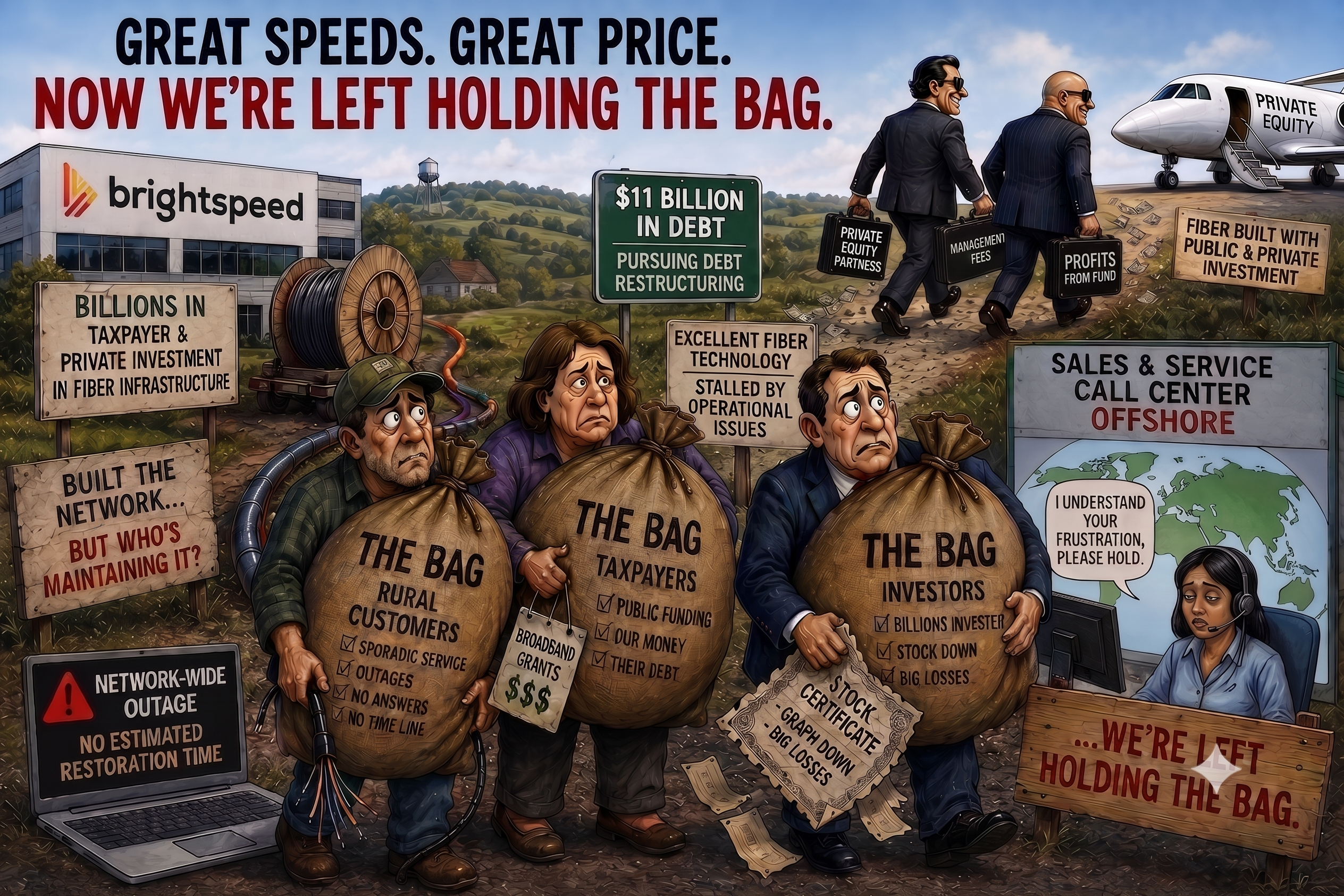
- The Debt: They are currently drowning in over $11 Billion in debt and sprinting through a massive debt restructuring.
- The Banks: The big Wall Street banks that funded this adventure just had to take a permanent $1.1 Billion financial “haircut” (a polite term for losing a fortune) just to keep the cables from becoming expensive underground decoration.
- The Billionaires: The executives at Apollo Global Management? Oh, they’re doing just fine, thank you. They don’t need Brightspeed to actually make money; their personal bank accounts are safely insulated inside a fortress of guaranteed management fees and overall fund profits. They take the upside, everyone else holds the bag. Such is the world!
The Taxpayer Trap
But the best part of the scam? The Taxpayer Trap. When a massive private-equity-backed firm swoops in and wins federal rural broadband grants, the government marks the area as “funded” on their maps.
Because double-dipping rules prohibit duplicate federal subsidies, these homes are now legally locked out of getting help from anyone else. So if the giant company stalls out, you get trapped in a regulatory limbo where no one else is allowed to save you. Brilliant, really.
Crawling Back to Spectrum
So, I am officially crawling back to Spectrum. A local sales rep (whose family I actually know) hooked me up with a 2-year $30 a month price lock at 500 Mbps and waived the install fee. Since I already wired the house with a custom mesh system, they literally just have to run a fresh line from the pole to replace the one Brightspeed chopped in half.
The catch? It won’t happen until the 29th because my buddy needs to hold the order to hit his next monthly quota. Honestly, I respect the hustle. I can comfortably tether to my phone for work until then. My poor partner is missing her TV shows, but hey—on the bright side, the local weeds are absolutely terrified of her now that she’s spending all her time in the garden.
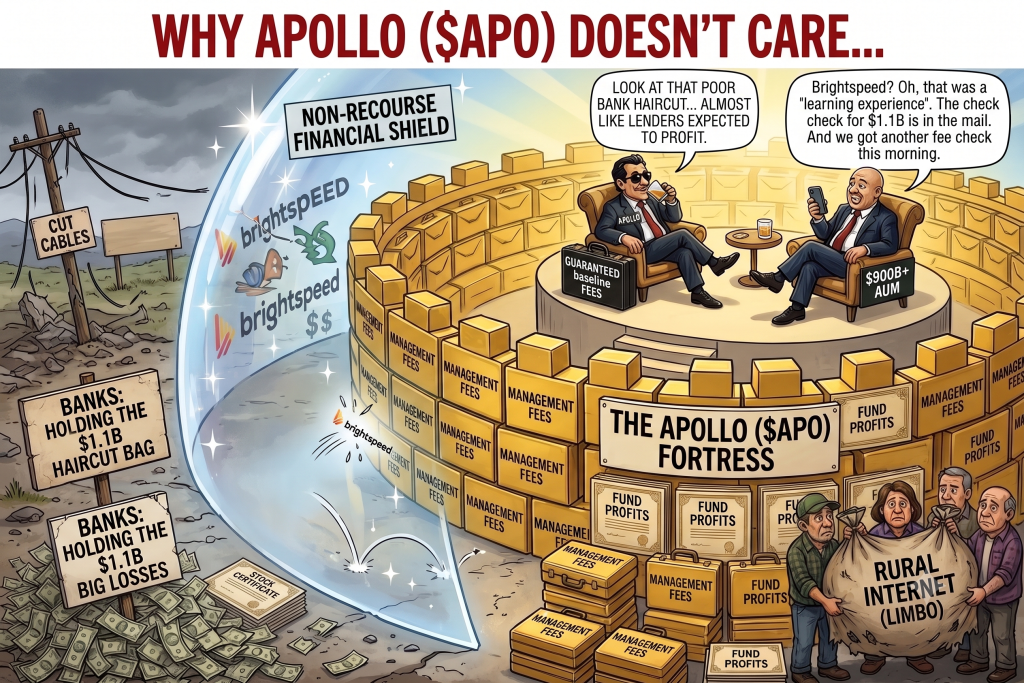
I plugged this whole corporate circus into an AI image generator to see how it would interpret the mess, and the editorial cartoon it spit out is a work of art. Check out the briefcases. 👇 Matrix of the modern world!
Why Apollo Doesn’t Care
Naturally, this raises an obvious question: Will any of this ground-level chaos actually affect Apollo Global Management’s stock (NYSE: APO)?
To answer directly: No, this will not meaningfully hit $APO, and they are essentially off the hook. Here is why a multi-billion-dollar telecom headache barely registers on Apollo’s stock ticker:
1. Brightspeed is a Drop in a Giant Ocean
Apollo manages around $1 trillion in assets across credit, real estate, and private equity. Brightspeed is just one individual portfolio company inside one of Apollo’s many private funds. Wall Street prices APO stock based on Apollo’s total fee-generating assets under management (AUM) and broad performance across hundreds of investments. A stumble by a single regional fiber project doesn’t put a dent in a financial juggernaut of that scale.
2. The Corporate Veil & Compartmentalized Debt
When Brightspeed accrued over $11 billion in debt, that debt was attached strictly to Brightspeed’s corporate entity—not to Apollo Global Management. If Brightspeed goes completely under, lenders cannot go after Apollo’s corporate balance sheet or bank accounts. The stock market knows this, so Brightspeed’s debt restructuring doesn’t impair Apollo’s overall financial health or dividends.
3. The Management Fee Machine Keeps Running
Even when a portfolio company struggles, the private equity model guarantees steady income. Apollo collects baseline management fees from the institutional investors (pension funds, university endowments) who commit capital to their funds. Because those fees are calculated on total committed capital rather than daily operational success, Apollo’s cash flow remains steady regardless of local service outages.
4. Where Apollo Actually Felt a Pinch
While the stock price remains insulated, Apollo didn’t escape completely untouched behind closed doors:
- Capital Sunk: Apollo and its lenders had to inject approximately $3.7 billion in new capital during the restructuring to keep Brightspeed afloat and protect their initial equity.
- Fund Returns: That specific Apollo fund will see lower overall returns, which means the fund managers miss out on a chunk of their performance bonus (“carried interest”) for that specific deal.
The Bottom Line
For Wall Street and $APO shareholders, Brightspeed is just a minor line item that didn’t go as planned. The banks absorbed the immediate $1.1 billion debt loss, Apollo’s fund doubled down with new capital to keep the lights on, and Apollo’s overall stock continues to trade based on its massive global portfolio.
As far as the stock market is concerned, the parent company is entirely insulated from the ground-level chaos.
Linked Sources & References
- PJT Partners: Restructuring & Special Situations — Brightspeed Liability Management (Official advisor record on Brightspeed’s liability management and debt refinancing)
- TIKR Financial Analysis: Apollo Global ($APO) Assets Under Management & Fee Earnings (Breakdown of Apollo’s fee-related earnings, total AUM growth, and balance sheet protection)
- Vernimmen Corporate Finance: Private Equity Leverage & Bank Debt Discounts (Analysis of lender debt haircuts and bank syndication losses in leveraged buyouts)
- Federal Communications Commission (FCC): Rural Broadband Accountability Plan (Details on broadband coverage mapping and grant anti-duplication rules)