
The Shiny Trap Flying Across Your Feed
Thinking about trading in the stock market? If you have spent any time online lately, you have probably run into slick videos of young, smiling “gurus” showing off sports cars, luxury vacations, and laptop screens glowing with bright charts. The pitch is almost always the same:
“Investing is too complicated, so I built a system that makes it simple. Just buy when the light turns green, and sell when the light turns red.”
During a strong stock market, these “red light, green light” trading packages crop up everywhere. They are specifically designed to attract everyday people who want to grow their savings but feel completely overwhelmed by the market. It sounds incredibly appealing—who wouldn’t want a simple traffic light telling them exactly how to get rich?
But you have to ask yourself the obvious question: if these gurus are so spectacularly good at printing money in the stock market, why on earth are they spending their afternoons editing TikTok videos and trying to sell you their “secret” system for $499 a month? If you had a literal crystal ball that accurately predicted the future of Wall Street, you wouldn’t be running Facebook ads or dealing with customer support emails—you’d be trading from a private island.
Of course, they will tell you they are doing this out of the goodness of their hearts, purely for the benefit of their students. Don’t buy it. The only bank account they are looking out for is their own. The reality is simple, if a bit cynical: they are making vastly more money off the people they “teach” than they ever have from actual trading.
The Illusion Under the Hood
When you peel back the expensive software interface, these systems almost always run on the exact same basic charting rules that you can get for free on any financial website. The “secret methodology” usually just boils down to standard, lagging indicators renamed to sound high-tech:
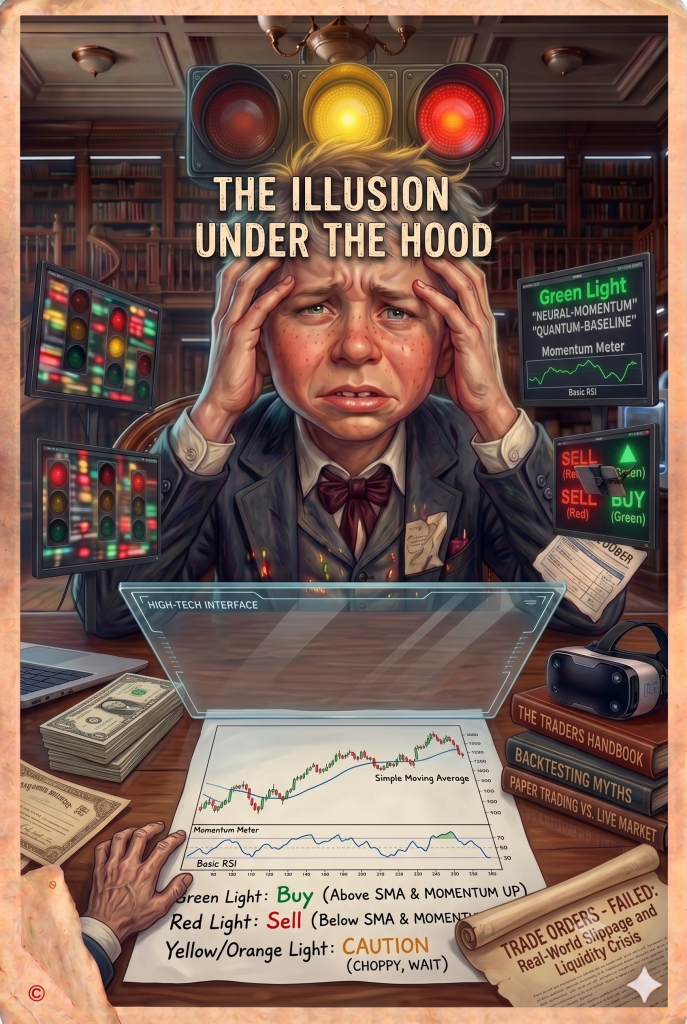
- Green Light (Buy): This happens when a stock’s price moves above a simple baseline average (like a standard moving average line) and a basic momentum meter shows buying strength.
- Red Light (Sell or Exit): The price drops below that baseline average, and the momentum meter shows selling pressure.
- Yellow/Orange Light (Caution): The market is choppy or moving sideways, meaning the indicators don’t perfectly align and you are told to wait on the sidelines.
The promoters tell you this is a bulletproof way to read the market. In reality, it is just a simplified visual trick that looks great on historical data but struggles in the real world when sudden market shifts cause the lights to rapidly blink back and forth.
To make matters worse, many of these gurus aren’t even trading with real money when they show you these signals. They are often showing you “backtests”—which just means running the software on old, historical data to find a perfect past scenario—or using “paper trading” practice accounts.
Neither of these methods accurately reflects how the live market actually trades. Fake accounts ignore real-world conditions like “slippage” (not getting the exact price you want) and the sudden lack of liquidity when everyone is trying to exit at the exact same time. It’s easy to look like a financial genius when there’s zero real money on the line.
Real Investing vs. The Flashing Light Show
When professional investors look at the market, they do not rely on a secret, color-coded crystal ball to guess the future. Instead, they use a transparent set of rules—almost like a business blueprint—to protect their cash.
Let’s look at a simple example of a real plan for buying regular shares of a stock. Instead of guessing or reacting to flashing colors, an investor sets up clear, mathematical rules before spending a single dollar:
- Asset: 100 Shares of Stock XYZ
- Action: Buy
- Entry Price: $50 per share
- Safety Rail (Stop Loss): Sell automatically if it drops to $45 to limit total risk.
- Profit Target: Sell automatically if it rises to $60 to capture the gain.
Notice how everything is completely out in the open. There are no secret flashing lights or hidden computer codes. A real plan relies on fixed numbers and clear boundaries. You know exactly what you stand to make and exactly what you stand to lose before you ever begin.
If you don’t understand this, then that is what the scam gurus are counting on in order to draw you in. They want you to think it’s too hard so you will hand over your money for their “simple” colorful buttons.
Welcome to the Digital Casino Floor
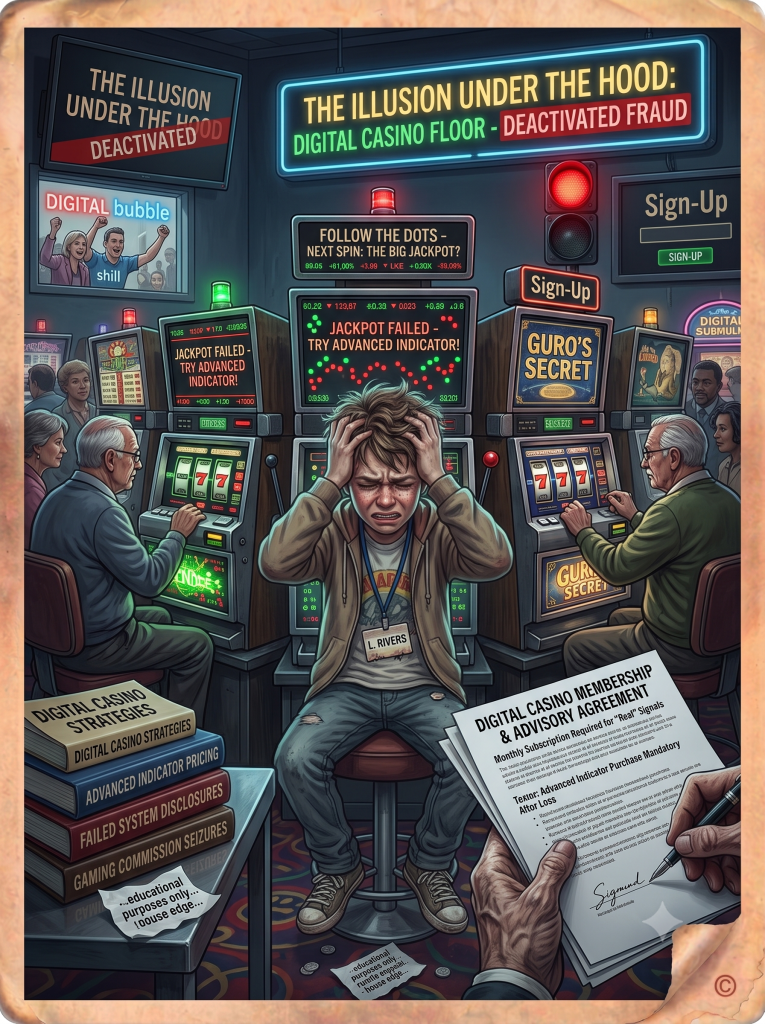
This entire setup functions exactly like a casino floor filled with rows of flashing slot machines.
Think of retirees sitting in front of the slots, pulling the lever over and over, hoping the next spin hits the big jackpot. That is exactly what happens when someone blindly follows a red or green dot. They keep feeding their hard-earned money into the market, convinced the next trade will be the big win. But just like in Vegas, the house always wins. The only ones guaranteed to come out ahead are the operators selling the “systems” to game a setup that cannot actually be gamed.
What makes this trap so dangerous is the ongoing string-along. When the software inevitably fails and you lose money, the guru never takes the blame. Instead, they tell you that you just haven’t unlocked the real secrets yet. They will pressure you into buying their “advanced” indicators, or force you to pay a monthly subscription to join a private chat group.
Inside these paid online communities, you are surrounded by a cheering section of other users. Some are just people who happened to get lucky during a hot market streak, while others are outright “shills”—paid accounts or fake profiles designed to hype up the system. They post screenshots of their supposed wins to convince new “investors” to keep paying their monthly dues. It creates a digital bubble that keeps you trapped while your trading account slowly drains away.
Inside these paid online communities, you are surrounded by a cheering section of other users. Some are just people who happened to get lucky during a hot market streak, while others are outright “shills”—paid accounts or fake profiles designed to hype up the system. They post screenshots of their supposed wins to convince new “investors” to keep paying their monthly dues. It creates a digital bubble that keeps you trapped while your trading account slowly drains away.
The “Catch Me If You Can” Reality
If you look at this landscape and think, “Why doesn’t the government just step in and stop this?”—you’ve hit on the most frustrating part of the entire industry. The hard truth is that regulatory agencies are often playing an endless game of whack-a-mole, and for a long time, the system lacked the teeth to create a real deterrent.

Civil agencies like the Federal Trade Commission (FTC) or the Commodity Futures Trading Commission (CFTC) can sue these operations, hand down multi-million dollar fines, and issue permanent trading bans. But to a seasoned scammer, a million-dollar fine is just a cost of doing business. They pay the fine out of the massive fortunes they extracted from their subscribers, shut down the old website, slightly tweak the name of the software, and launch a brand-new social media campaign under a corporate shell company two months later.
Because these are traditionally handled as civil consumer fraud cases rather than criminal ones, actual prison sentences have been historically rare. Scammers know how to walk right up to the legal line, using tiny, buried terms-of-service disclosures that read “Results not typical; for educational purposes only” to protect themselves from criminal prosecution.
However, the legal landscape is slowly forcing a shift. Recognizing that simple fines weren’t working, federal agencies have started building task forces specifically focused on aggressive retail fraud. They are partnering directly with the Department of Justice to turn these civil scams into coordinated criminal indictments for wire fraud and money laundering—crimes that carry heavy federal prison time. Instead of just writing checks, prominent ringleaders are increasingly facing massive asset forfeitures, losing their luxury cars, private planes, and real estate, and actually getting handed multi-year prison sentences.
Still, the wheels of justice turn slowly. By the time a regulatory agency builds a case, shuts down a network, and strips the operators of their wealth, thousands of everyday investors have already been wiped out.
How to Protect Your Wealth
Building long-term wealth in the stock market does not come from buying a shiny, expensive traffic light software. If you want to avoid the traps and trade the right way, keep these rules at your desk:

- Close Your Door to the Hype: If an investment plan is hidden behind flashing colors, expensive subscription groups, or high-pressure pitches, walk away.
- Demand Transparency: A legitimate investment structure never relies on hidden computer code. Look for fixed target numbers, clear timeframes, and explicit safety rails you can see before spending a dollar.
- Ignore Fake Accounts: Never trust screenshots of massive profits built on historical “backtests” or practice “paper trading” simulator accounts. Real market conditions behave completely differently.
- Focus on the Math: True stability in the stock market comes from learning the real, unglamorous math of risk management and relying on structural probabilities—not commercial gimmicks.
Sources & Further Reading
- Federal Enforcement Action: For the complete legal background on the $362 million judgment, debt forgiveness framework, and the forced asset surrenders (including the Cessna airplane and Bentley), see the official FTC Online Trading Academy Case Summary.
- Social Media Fraud Statistics: For the raw data detailing the $2.1 billion in total social media scam losses and the $1.1 billion specifically lost to digital investment schemes, see the FTC Data Spotlight: Reported Losses to Scams on Social Media.
- Background Verification: To cross-reference any individual promoter, coaching program, or firm name against active regulatory databases, utilize the FINRA BrokerCheck Database and the Investor.gov Background Check Portal.
- Reporting Tools: To report aggressive trading setups or deceptive wealth-building software platforms directly to federal authorities, use the FTC Report Fraud Assistant.
Official Enforcement Actions & Case Files
- The Online Trading Academy Precedent: Read the complete federal case details, including the $362 million judgment, debt forgiveness mandates, and the asset surrender logs (including the Cessna 400 and Bentley Mulsanne) at the FTC Online Trading Academy Case Index.
- Deceptive Marketing Law: Understand the legal framework regulators use to prosecute these operations by reviewing the FTC Act Section 5: Unfair or Deceptive Acts or Practices.
Social Media Scam Data & Consumer Alerts
- Social Media Fraud Statistics: Review the underlying data showing the $2.1 billion in total social media scam losses and the $1.1 billion lost exclusively to digital investment schemes via the FTC Data Spotlight on Social Media Fraud.
- Commodity & Futures Trading Warnings: Read the consumer alerts issued regarding color-coded commodity and derivative schemes on the CFTC Customer Advisory: Avoid Fraudulent Trading Seminars and Signals.
- Federal Fraud Video Briefing: Watch the visual breakdown of how modern algorithms are weaponized to target retail investors in the official FTC Consumer Protection Video Summary.
Investor Protection & Verification Tools
- Professional Credentials Database: Verify if an individual or program is legally licensed to manage capital or offer advice using the Investor.gov Background Check Portal.
- Firm Disciplinary History: Research consumer complaints, employment histories, and regulatory penalties of any broker or educational firm through the FINRA BrokerCheck Tool.
- Reporting Predatory Schemes: If you have encountered a deceptive trading system or high-pressure seminar, file an official report using the FTC Report Fraud Assistant.