

Locking in Profit and Resetting the Trade
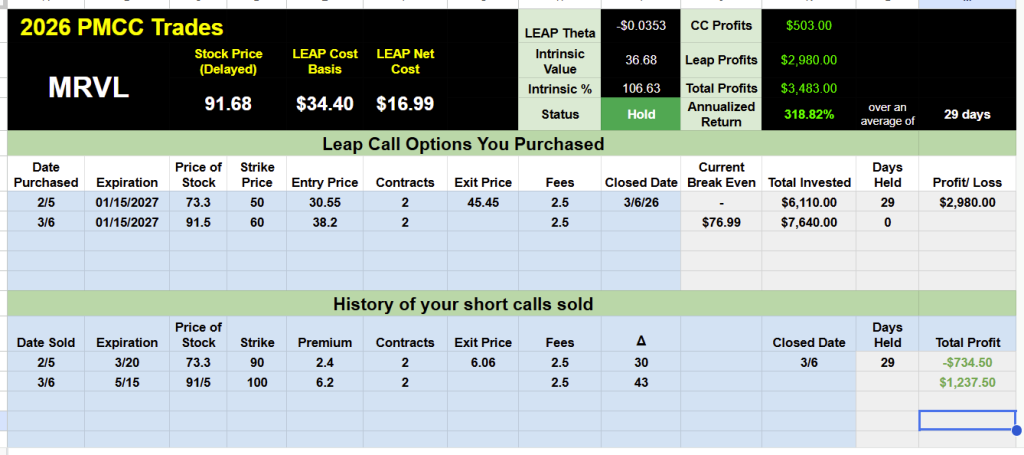
After a strong move higher in Marvell, I made a management adjustment to my Poor Man’s Covered Call (PMCC) position. When a stock rallies quickly, two things tend to happen: the short call starts getting crowded, and a large portion of unrealized profit builds up inside the long LEAP.

Rather than simply rolling the short call and leaving that profit trapped, I chose to ratchet the entire position higher and extract some of the gains while keeping the trade alive.
📊 The Situation
Marvell had pushed into the low $90s, putting pressure on my short call while my LEAP had accumulated significant intrinsic value.
Original Position
| Leg | Position |
|---|---|
| 🟢 Long | Jan 17, 2027 $50 LEAP |
| 🔴 Short | March 30 $90 Call |
| 💰 Stock Price | ~ $92 |
At this point, the trade had done exactly what it was supposed to do. The stock moved higher and the LEAP appreciated significantly.
The key question became:
How do I lock in some of that gain while keeping the bullish position intact?
🔧 Step 1 – Rolling the LEAP Higher
The first adjustment was to roll the LEAP up in strike and extract some of the intrinsic value that had built up.
LEAP Adjustment
| Adjustment | Credit Collected |
|---|---|
| 🔁 Jan 2027 $50 → Jan 2027 $60 | 💵 $7.25 credit |
🎯 Why roll the LEAP?
This move accomplishes several things:
✔ Locks in a portion of the stock’s move
✔ Pulls cash out of the position
✔ Reduces capital tied up in the trade
✔ Maintains strong bullish exposure
Even after the roll, the $60 LEAP still carries a high delta, meaning the position continues to participate heavily if the stock keeps climbing.
This technique is often referred to as “ratcheting the LEAP” — gradually moving the long strike higher as the underlying stock trends upward.
🔄 Step 2 – Resetting the Short Call
With the stock now trading near my short strike, the next step was to create more breathing room on the upside.
My original short call was the March 30 $90 call, which had become too close to the current price. I evaluated a couple of possible rolls.
Short Call Roll Candidates
| Roll Option | Credit | Time Added | Pros | Cons |
|---|---|---|---|---|
| 🔁 Mar 30 $90 → Apr 24 $95 | $0.17 | ~6 weeks | Slightly higher credit | Strike still too close |
| 🔁 Mar 30 $90 → May 15 $100 | $0.14 | ~10 weeks | Creates real upside room | Smaller credit |
🧠 Why I Chose the $100 Strike
While the April $95 call offered a slightly larger credit, it would have left the trade too tightly capped. If the stock continued higher, I would likely be forced into another adjustment almost immediately.
Instead, I rolled out and up to the May 15 $100 call, collecting 💵 $0.14 credit.
The goal here wasn’t squeezing every last penny of premium — it was giving the trade room to run.
💰 Total Credit Extracted
| Source | Credit |
|---|---|
| 📥 LEAP Roll | $7.25 |
| 📥 Short Call Roll | $0.14 |
| 💵 Total Credit | $7.39 ($739 per contract) |
This adjustment effectively pulls realized profit out of the position while keeping the trade intact.
🧩 The New Structure

After the adjustments, the position now looks like this:
| Leg | Position |
|---|---|
| 🟢 Long | Jan 17, 2027 $60 Call |
| 🔴 Short | May 15 $100 Call |
This creates a much wider operating range and resets the position for continued bullish exposure.
⭐ Why This Adjustment Matters
One common mistake with PMCC trades is only rolling the short call, leaving a large unrealized gain trapped inside the LEAP.
By rolling the LEAP higher, I was able to:
✔ Lock in part of the rally
✔ Reduce capital at risk
✔ Maintain strong upside exposure
✔ Extend the life of the trade
The position is now effectively reset and ready to continue generating income.
🗺 The Plan Going Forward
From here I’ll monitor the position and manage it as price action develops.
🚀 If the stock continues higher toward $100
I may roll the short call higher again to reopen more upside room.
⏳ If the stock stalls or trades sideways
The May call will decay and I’ll continue harvesting theta.
⚠️ If the stock pulls back
The extracted credit helps cushion the downside.
🏁 Final Thoughts
This adjustment is a good example of how a PMCC can be actively managed rather than simply held.
Instead of closing the trade after a strong move, the position was reset and repositioned so it can continue benefiting if the bullish trend persists.
For now, the trade has been reset, profit has been locked in, and the position has plenty of room to work.
Leave a Reply