
Status: Active | Asset Class: SPX (Index) | Trader Archetype: The Volatility Merchant
One-Page System Summary (Read Before Every Trade)
Trade Construction (Non-Negotiable)
| Component | Rule |
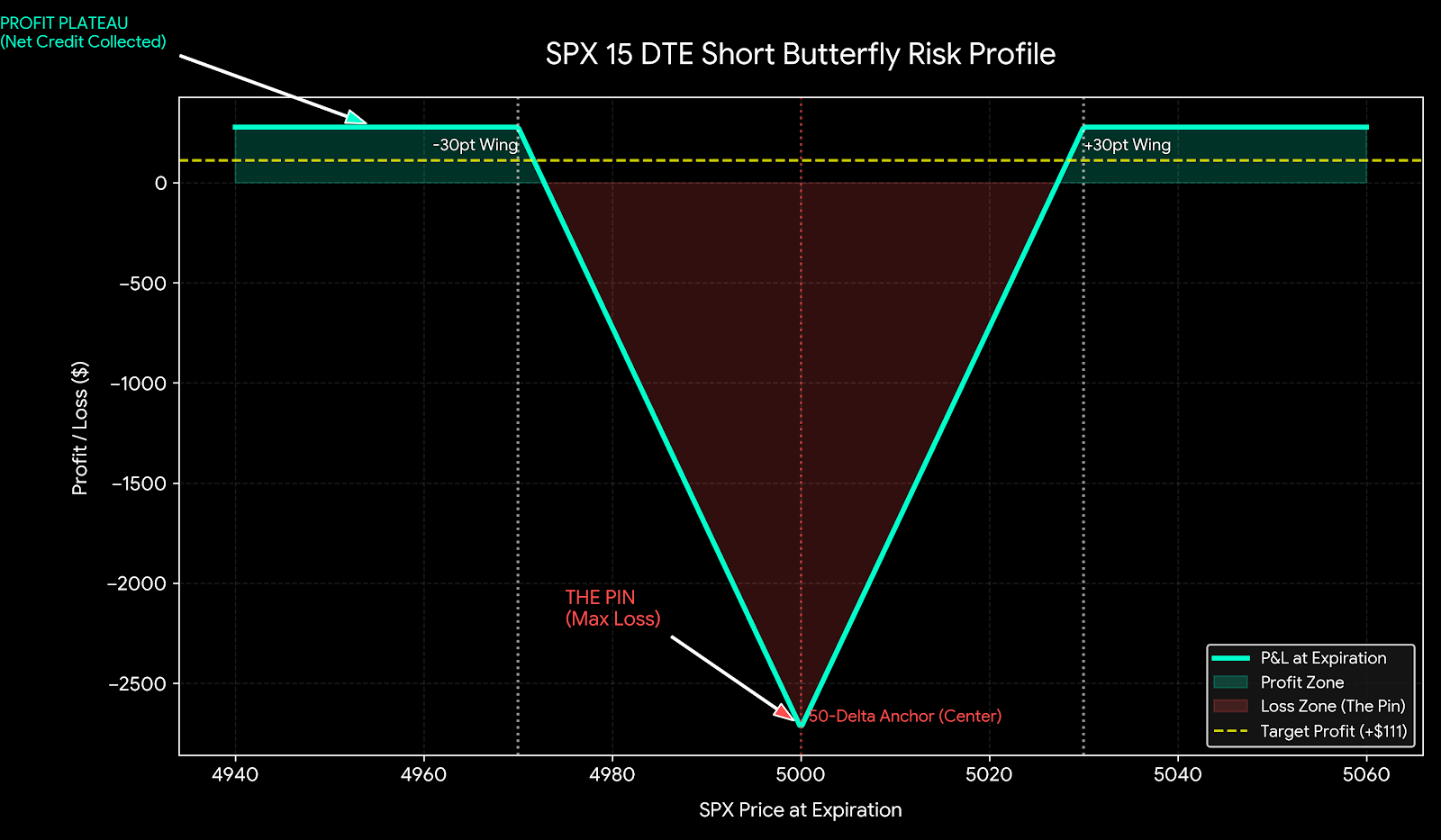
| Structure | Short Butterfly (Buy 2× ATM Body / Sell 1× ITM Wing / Sell 1× OTM Wing) |
| Strike | Center (Body) at 50 Delta; Wings at +/- 30 point offsets |
| Option Type | SPX Puts (Cash-settled, preferred skew) |
| Entry Timing | Daily @ 12:00 PM ET only |
| Trade Type | Net Credit, Short Gamma, Volatility Neutral bias |
Export to Sheets
Entry Checklist (All Must Be True)
| Check | Requirement |
| Expiration | Target 15 DTE exactly (or closest available) |
| Direction | No bias; center at current spot price |
| Strike Width | Equidistant wings (exactly 30 points from center) |
| Net Premium | Must receive a Net Credit (Ensure “Sell to Open” credit) |
| Allocation | Max 1 contract per daily tranche (Risk control through laddering) |
Export to Sheets
Management & Exit Rules
| Rule | Action |
| Profit Target | 40% of Credit received (Set GTC Limit Buy Order immediately) |
| Hard Stop | None (System accepts the “Pin Risk” as part of the edge) |
| Time Exit | 0 DTE @ 3:00 PM ET — Take it as priced if target not hit |
I. THE PHILOSOPHY: THE MOVEMENT MERCHANT
- The Core Belief: The market is rarely stationary. We do not predict direction; we bet against stagnation.
- The Goal: “Short the Pin.” We harvest the premium that investors pay for the market to stay exactly where it is.
- The Statistical Edge: Historical SPX data shows that the index stays within a ±0.5% range over a 15-day period less than 5% of the time. We are trading the other 95%.
- The “Movement” Requirement: You are not looking for a “Moonshot.” You only need the SPX to drift roughly 1% in either direction at any point during the 15-day window to trigger your 40% GTC profit target.
- The Mindset: You are an insurance seller who hopes for a minor accident. You don’t care if the car goes left or right, as long as it doesn’t stay parked in the middle of the intersection.
II. BUILDING THE BUTTERFLY: CONSTRUCTION
1. Strike Selection (The 50-Delta Anchor)
- The Body: Buy 2× 50-Delta Puts (At-the-Money). This is the “Center” of your trade.
- The Wings: Sell 1× Put (+30 pts) and Sell 1× Put (-30 pts). These are your “Profit Plateaus.”
2. The Skew Advantage (Why Puts > Calls)
We exclusively use Puts for structural reasons:
- Fear Premium: SPX Puts carry “Put Skew.” Out-of-the-money puts trade at higher Implied Volatilities (IV) than calls because investors pay a premium for downside protection.
- Higher Yield: Selling “expensive” Put wings results in a larger Net Credit. This creates a shallower “Pit” and a wider “Profit Valley.”
- Liquidity: The SPX Put chain is the most liquid options market in the world, ensuring tighter fills when “walking” your limit orders.
3. The 15 DTE Lifecycle
- Gamma Ramp: Gamma is manageable at 15 days, providing a smoother P&L. However, it accelerates violently inside 5 DTE. This is why we aim for the 40% exit early.
- Theta Inversion: This is the magic of the Short Butterfly.
- At the Center: You are “paying rent” (Negative Theta).
- At the Wings: As the price moves toward your wings, the decay of the short wings accelerates, flipping the trade into a “collecting” state where time becomes your friend.
III. THE GREEK ENGINE (THE MECHANICS)
| Greek | Position | The Nuance |
| Delta | Neutral | At entry (50-Delta), you have no directional bias. As the market moves, the trade becomes “directional” toward the profit wings. |
| Gamma | Short | This is the “Speedometer.” It is highest at the center. Movement away “deflates” this risk, making the P&L more stable as you reach the wings. |
| Theta | Negative | You pay “rent” to sit at the center. However, once the price drifts to the wings, the decay of the short options accelerates, flipping the trade into a “collecting” state. |
| Vega | Positive | A spike in the VIX (Fear) helps you while you are in the center “pit” by inflating the value of your long body more than your short wings. |
The “Greek Lifecycle” Notes:
- The Gamma Squeeze: Inside 5 DTE, Gamma becomes explosive. This is why the 3:00 PM Rule in Section VII is non-negotiable—it prevents a last-minute price flicker from causing a massive P&L swing.
- The Vega Exit: If the market moves 20 points away and the VIX simultaneously crashes, your 40% GTC target will often hit instantly. This is the “Movement Merchant’s” favorite scenario.
IV. THE “NEGATIVE CONVEXITY” TRAP
1. The Math of the Edge
- Average Winner: ~$111 (The 40% Target).
- Max Loser (The Pin): ~$730 (The “Pit”).
- The Math: To remain profitable, you need a win rate higher than 87%. Because the “Movement” requirement (Section I) is so high, this strategy historically achieves a win rate closer to 95-98%.
2. The Pin Risk (The Center Strike)
If SPX closes exactly at your center strike at expiration, you suffer the maximum loss.
- The Reality: “Pinning” a 15 DTE trade at expiration is mathematically difficult. The market would have to return to the exact price from 15 days ago and stop moving.
- The Defense: The Ladder (Section IX) ensures that if one trade is “Pinned,” your other active trades are likely in deep profit zones, buffering the blow.
3. The “No Stop Loss” Commandment
Absolute Rule: Do Not Use Mechanical Stop Losses.
- The Noise Trap: The “Profit Valley” is narrow. In a 15 DTE window, SPX will often swing through your “Loss Pit” multiple times.
- The Logic: A mechanical stop loss will trigger on temporary “noise,” closing a trade for a loss that would have eventually drifted into a 40% profit plateau.
- The Only Stop Loss: Your stop loss is your Position Sizing (Section VIII). You accept the $730 risk upfront in exchange for the high probability of the $111 win.
V. TRADER WORKFLOW: THE LADDER
1. The Entry Ritual
- Timing: Every day at 12:00 PM – 12:15 PM ET, check the option chain for the 15 DTE expiry.
- The Anchor: Find the Put strike closest to 50 Delta.
- The Structure: Build the 1-2-1 Short Butterfly (Buy 2 Center / Sell 1 Upper / Sell 1 Lower).
2. “Walking the Limit” (Execution)
- The Mid-Price Rule: Send the order as a Limit Order exactly at the Mid-Price.
- The 2-Minute Drill: If the order is not filled within 2 minutes:
- Cancel the order.
- Replace it, moving the credit price by $0.05 (decreasing your credit).
- Repeat until filled. NEVER use a Market Order.
3. Immediate Automation (Target Setting)
- The 40% GTC: The moment you receive a fill, calculate your exit price:
- Exit Price = Entry Credit × 0.60
- Example: If you collected $4.50, set a GTC Limit Buy to close at $2.70.
- Rationale: This ensures that if the SPX “teleports” into the profit zone during a quick move or at the market open, you are out before the price can snap back.
4. The 0 DTE Termination (Monitoring)
- The Hard Stop: If the GTC order has not filled by 3:00 PM ET on the day of expiration (0 DTE), you must close the trade manually.
- Reasoning: After 3:00 PM, market makers widen their spreads, and “Gamma Risk” becomes toxic. Closing at 3:00 PM protects your capital from the “final hour” chaos.
VI. THE EXIT CHALLENGE: NAVIGATING LIQUIDITY
1. The Bid-Ask Friction (The 4-Leg Tax)
In SPX, a $0.10 spread per leg equals a $0.40 ($40 per contract) “tax” on the structure.
- The Rule: Never market in or out.
- The Tactic: Use “Walking Limit Orders.” Move your price by $0.05 every 60 seconds. This forces the market makers to compete for your order rather than you paying their “lazy” price.
2. The “Delta-Neutral” Stall (The Psychological Trap)
If the market is “Pinned” at your strike, your Delta is zero. The trade will feel “stuck,” “heavy,” or unresponsive to SPX movement.
- The Cause: This is Negative Gamma at its peak. Because you are perfectly balanced at the bottom of the “pit,” small movements don’t change the P&L much.
- The Cure: Patience. You need a breakout to “unstick” the P&L. Do not assume the trade is “broken” just because it isn’t moving; it is simply waiting for momentum to carry it toward a wing.
3. The GTC “Escape Hatch”
The GTC (Good ‘Til Canceled) Limit Buy at 40% profit is your Mechanical Insurance.
The Advantage: A human cannot react fast enough to click “Close” during these spikes. The GTC order is sitting on the exchange, ready to “snatch” that profit the millisecond it becomes available.
The “Flash Profit”: High-gamma periods (near 0 DTE) often cause “price spikes” where the SPX briefly touches your profit zone and then reverses.
VII. KNOWN TRAPS, NUANCES & BLACK SWANS
This section governs both the “Normal” market quirks and “Extreme” events.
1. Market Mechanics (The Movement Merchant’s Edge)
- The Vacuum Effect: Between 5 DTE and 2 DTE, if the market has moved 40+ points away, the extrinsic value of the wings (your shorts) often evaporates. This creates a “profit pull.” Don’t wait for more—take the 40% and move on.
- The “V” Recovery: This is the most dangerous scenario. If the market moves away and then “rips” back toward your center strike on 0 DTE, a 40% winner can turn into a max loss in minutes. Trust the GTC order; do not move the goalposts.
- The 3:00 PM Rule: On 0 DTE, market makers pull liquidity. Exiting at 3:00 PM protects you from final-hour “Gamma Pins” and price distortions that make closing the trade nearly impossible or unfairly expensive.
2. Volatility & Gaps (The Professional Edge)
- The Vega Buffer: In the “Pin Pit,” a VIX spike (fear) is your friend. It inflates your 2 Long Puts more than your short wings. This “cushions” the unrealized loss on your screen.
- The Black Swan Protocol: Weekend gaps or “Limit Down” events usually benefit you. They “teleport” the price out of the center valley and onto a profit plateau. Never buy “insurance” or hedge for weekends. You are paid to accept the risk that the market will move.
3. The Absolute Guardrail: No Legging Out
- Closing Longs first = Naked Shorts. This triggers an instant Margin Call and exposes you to infinite risk.
- Closing Shorts first = Naked Longs. This causes immediate, massive Theta bleed and rapid value decay.
- The Commandment: You enter as a 4-leg package; you exit as a 4-leg package. No exceptions.
VIII. CAPITAL ALLOCATION & MARGIN DISCIPLINE
To maintain the high win rate, you must survive the rare 0.6% “Pin” event. Over-leveraging is the only way this system fails.
1. The “Rule of 10” (Survival Math)
For every 1 unit (contract) you open, you must have enough capital to cover 10x the Maximum Loss.
- The Logic: This ensures a “Pin” event (max loss) only draws down your account by 10%. This buffer allows you to keep the rest of the Ladder running so the 99.4% win rate can recover the loss.
- The Discipline: Do not be fooled by “Buying Power” requirements. Your account size dictates your size, not the broker’s margin requirement.
2. Vehicle-Specific Allocation Table
| Vehicle | Max Loss (The Pin) | Recommended Capital | Scaling Strategy |
| SPX | ~$730 | $7,500 – $10,000 | Add 1 unit for every $10k in profit. |
| ES | ~$365 | $4,000 – $5,000 | Best for SPAN margin efficiency. |
| MES | ~$36 | $500 – $750 | Best for “Learning the Ladder.” |
3. Margin Type Awareness
- Reg-T (Standard): Usually requires the “width” of the spread (e.g., $3,000). This naturally throttles your size and keeps you safe.
- Portfolio Margin (PM): May only require $500–$800. Warning: Just because you can open 10 contracts doesn’t mean you should. Stick to the Rule of 10 regardless of the margin type to avoid a “Black Swan” liquidation.
IX. THE LADDER & TRAINING WHEELS
1. The Laddering Effect (Time & Price Diversification)
- The Entry Cadence: Enter a new 15 DTE trade every 1–2 days. Never put your entire allocation into a single expiry.
- The “Self-Hedging” Mechanics: Because the market is constantly moving, each rung of your ladder will have a different Center Strike.
- The Scenario: If the market stays flat and “Pins” (max loss) your Monday trade, it has almost certainly moved away from the Center Strikes of your previous Friday or Wednesday trades.
- The Result: The profits from the other rungs buffer the loss of the pinned rung. You are diversifying across Time and Price.
2. The MES Path to Pro (Scaling Strategy)
Do not rush to SPX. Master the mechanics where the “mistake cost” is low.
- Phase 1: The Mechanic (1 MES Contract): Complete 10 full trade cycles. Your goal isn’t profit; it’s mastering “Walking the Mid” and the 3:00 PM Exit.
- Phase 2: The Load (10 MES / 1 ES): Once Phase 1 is profitable, scale to 10 MES contracts. This equals the notional value of 1 E-mini (ES) but allows you to “scale out” of the position (e.g., closing 5 contracts at 30% and 5 at 40%).
- Phase 3: The Professional (SPX): Transition to SPX once your account supports the Rule of 10.
- The Prize: Section 1256 Tax Advantage. In the US, SPX profits are taxed as 60% Long-Term / 40% Short-Term capital gains, regardless of how long you held the trade. This can increase your net take-home pay by 10–15% compared to MES/ES.
X. THE POST-TRADE REVIEW (THE FEEDBACK LOOP)
Success in the Movement Merchant system isn’t measured by profit, but by execution consistency.
1. The “Pin” Analysis
If you hit a “Pin” (Max Loss), ask these three questions:
- Did I enter at 50 Delta? (If you entered at 40 Delta, you skewed your own risk).
- Was the Ladder staggered correctly? (Did you have other rungs that profited?).
- Was it just a statistical “0.6%” event? (If yes, accept it and move to the next trade).
2. The Slippage Audit
Every 10 trades, look at your entry credits.
- If you are consistently getting filled $0.15 below the Mid-Price, you are “chasing” the trade.
- Improvement: Slow down your “Limit Walk.” Be more patient at 12:00 PM.
3. The “Early Exit” Temptation
Review any trades you closed before the 40% GTC or the 3:00 PM rule.
- Rule: If you closed early because you were “scared,” you are interfering with the math.
- Adjustment: Reduce your position size until you can let the GTC order do its job without manual intervention.