
Investment Rating Section
Investment Rating:
BUY (High-Conviction Value Opportunity)
The Verdict:
Boston Scientific is a pristine med-tech compounding machine whose stock has been unfairly punished by temporary digestion pain from its $14.50 billion Penumbra acquisition, giving long-term value investors an exceptionally rare 15.5x multiple on Owner Earnings.
Current Market View:
The market is panicking over short-term integration dilution and a slight deceleration in the electrophysiology segment, completely missing the long-term cash power of its newly FDA-approved product lines.
Valuation Framework:
17.5-20x normalized trailing Owner Earnings.
Fair Value & Investment Range
| Metric | Estimate |
| Current Share Price | ~ $42.68 |
| Current P/E Multiple | ~ 17.86x |
| My Fair Value Range | $48 – $55/share |
| Attractive Buy Zone | $38 – $45/share |
| High-Conviction Opportunity | Below $38/share |
| Valuation Framework | 17.5-20x normalized Owner Earnings |
| Margin of Safety Needed | 15-20% discount to Fair Value |
Investment View
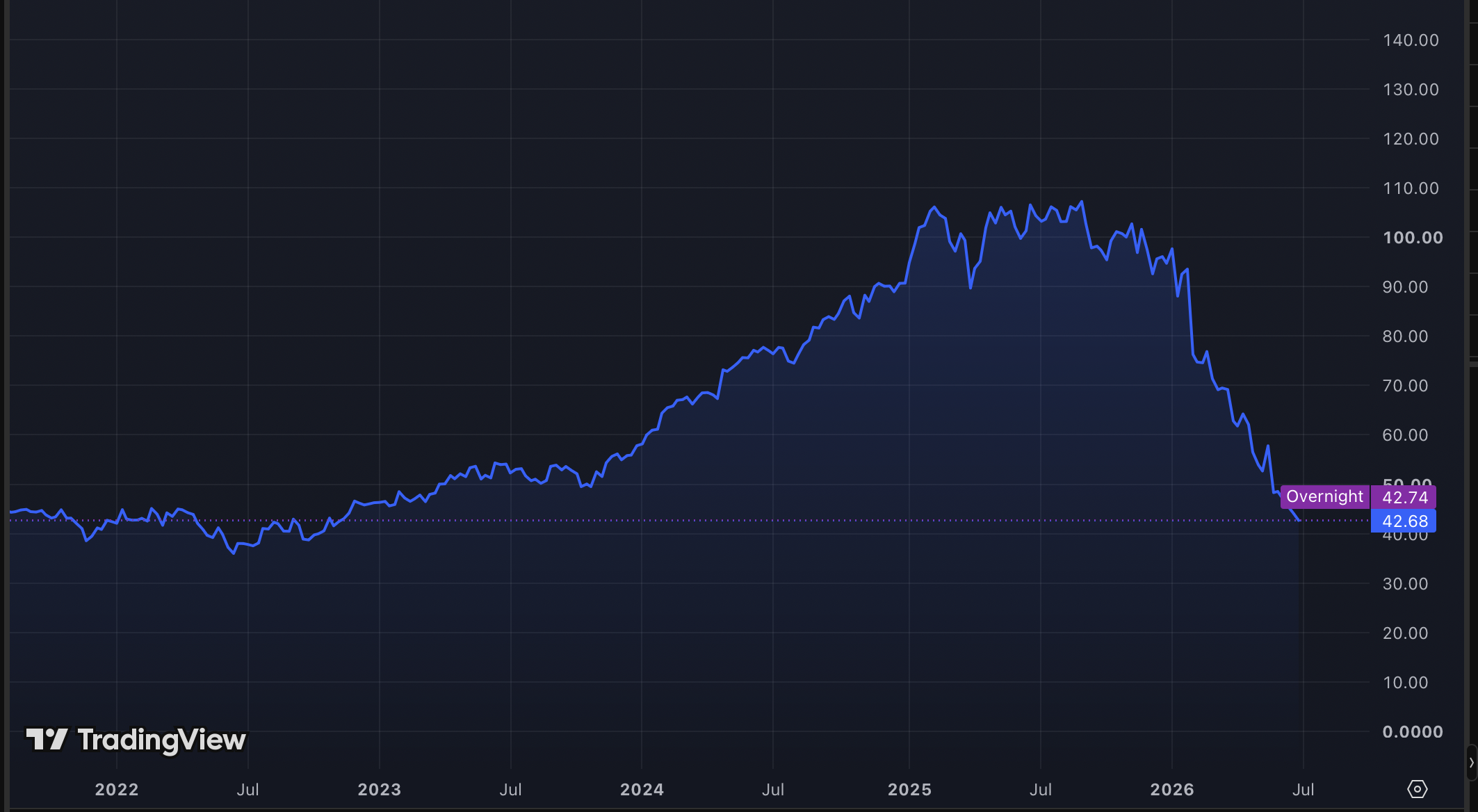
The question is not whether the company is good — the question is whether the current price offers an equity coupon rate high enough to satisfy a disciplined value investor. At $42.68 per share, Boston Scientific is trading at a level we have not seen in years, following a staggering 58% peak-to-trough collapse.
This drop is a classic market overreaction. Wall Street is currently pricing BSX as if its double-digit organic growth engine is permanently broken, rather than adjusting to a minor post-acquisition integration phase.
By valuing the company through our strict Owner Earnings framework, we find that BSX is yielding an implicit equity coupon of 6.44%. For a business with intense customer lock-in, high regulatory barriers to entry, and secular demographic tailwinds, buying at 15.52x Owner Earnings provides a highly attractive margin of safety against permanent capital loss.
Fair Value Uncertainty
Fair Value Uncertainty: Medium
The uncertainty is not primarily about:
- Business durability: The global demand for minimally invasive cardiovascular and neurovascular procedures is structurally guaranteed to grow over the next two decades as the global population ages.
- Competitive position: Boston Scientific maintains a dominant, near-duopoly share in core product markets like left atrial appendage closure (Watchman) and pulsed field ablation.
- Revenue stability: Over 90% of the company’s clinical implant and catheter sales are recurring, non-discretionary procedures that hospitals cannot defer.
The main variables are:
- The digestion speed of the $14.50 billion Penumbra acquisition, which is diluting immediate GAAP earnings but holds the key to capturing the high-growth neurovascular thrombectomy market.
- Slowing growth trends in the U.S. Watchman franchise, as clinical penetration reaches mature mid-cycle phases.
- Regulatory approval timelines and initial commercial launch velocity for next-generation systems like the SEISMIQ coronary lithotripsy catheter.
Investor Watch Point
What price or event would change the investment thesis? We are monitoring the closing and initial integration steps of the Penumbra deal. A failure to realize expected synergies within 18 months, or a prolonged deceleration of organic Electrophysiology segment growth below 8%, would force us to revise our normalized Owner Earnings target downward.
Investment Snapshot
| Metric | Current View |
| Company | Boston Scientific Corporation (BSX) |
| Business Description | Global developer and manufacturer of minimally invasive medical devices for interventional specialties. |
| Market Cap | ~ $63.44 billion |
| Current Share Price | ~ $42.68 |
| Current P/E | 17.86x |
| Forward P/E | 12.43x |
| P/Owner Earnings (P/FCF) | 15.52x |
| Owner Earnings Yield | 6.44% |
| Dividend Yield | 0.0% |
| IV Rank | 92.8% |
| Implied Volatility | 98.9% |
| Wall Street Consensus Target | $78.50 (Sentiment: Neutral) |
| Value Investor Target Multiple | 17.5-20x Owner Earnings |
| Initial Buy Zone | $38 – $45/share |
Investment Thesis
Boston Scientific came across my radar because its stock price has suffered a jaw-dropping 6-day cascade, dropping 17% and entering a full-scale 58% yearly correction, pushing the option implied volatility (IV%) to an extreme 98.9% and an Implied Volatility Rank (IVR) of 92.8%.
This extreme volatility is the result of institutional panic. Mainstream analysts are aggressively downgrading the stock because of near-term EPS dilution from the Penumbra purchase and a slightly conservative 2026 outlook for its electrophysiology division.
This is a classic “screener illusion.” Mainstream models look at GAAP net income and see a messy, acquisition-heavy balance sheet with compressed accounting margins.
But as value investors, we look past the non-cash amortization and integration expenses. What we find underneath is an incredibly robust, highly profitable clinical engine that continues to churn out substantial owner cash.
Business Quality: Highly Defensible Cardiovascular and MedSurg Moat
Simple and Understandable: Boston Scientific designs and manufactures premium, single-use catheters, stents, pacemakers, and implants. These products are clinical necessities that doctors use daily to save lives and shorten hospital stays.
Durable Economic Moat (Competitive Advantage): The company enjoys a powerful three-pronged moat. High regulatory switching costs prevent hospitals from easily changing vendors; surgeons face immense career risk if they deviate from the gold-standard Boston Scientific devices they were trained on; and a vast library of intellectual property protects high-margin product franchises like Watchman.
High Returns on Invested Capital (ROIC): Because medical device manufacturing relies on highly specialized intellectual property rather than massive heavy machinery, BSX operates an incredibly capital-light business model. The majority of cash flow can be directed toward R&D and strategic acquisitions rather than physical maintenance.
Financial Strength: The Good
Revenue Growth
Boston Scientific has demonstrated strong secular growth, with revenue compounding from $16.70 billion in FY24 to $20.10 billion in FY25. Even with the market’s current anxiety over a temporary U.S. slowdown, the underlying demand for its core cardiovascular products remains highly insulated from broader economic cycles.
Free Cash Flow & Owner Earnings Machine
To find the true economic productivity of this business, we must look beyond reported GAAP Net Income, which is heavily distorted by amortization from acquisitions. Instead, we calculate trailing Owner Earnings using the classic formula:
Owner Earnings = Net Income + Depreciation & Amortization – Average Capital Expenditures
Using the actual figures from the most recent four quarters:
| Quarter | Free Cash Flow (or Net Income + D&A – CapEx) |
| Q1 2026 | $1,513.00 million |
| Q4 2025 | $684.00 million |
| Q3 2025 | $916.00 million |
| Q2 2025 | $974.00 million |
The company generated approximately: $4,087.00 million in trailing annualized Owner Earnings.
This highlights a spectacular conversion rate of cash. While reported GAAP earnings are weighed down by non-cash charges, the actual cash flow returning to the corporate coffers is immense, leading to a robust 15.52x Price-to-Owner-Earnings multiple at today’s market price.
Balance Sheet: The Strength
| Metric | Amount |
| Cash | ~ $1,453.00 million |
| Total Debt | ~ $11,029.00 million |
| Net Debt | ~ $9,576.00 million |
| Debt/EBITDA | 2.13x |
| Net Debt/Owner Earnings | 2.34x |
While the $14.50 billion Penumbra acquisition has led to a noticeable increase in leverage, the debt profile remains entirely manageable. At a Net Debt-to-Owner-Earnings ratio of just 2.34x, Boston Scientific can easily pay down its liabilities using its highly predictable operational cash flows.
Valuation: The Main Opportunity
| Metric | Multiple |
| P/E Ratio | 17.86x |
| Forward P/E | 12.43x |
| Price / Owner Earnings | 15.52x |
| EV / EBITDA | 13.28x |
The current market valuation has priced in a worst-case scenario. Wall Street analysts have rapidly slashed price targets to the $64-$70 range, panicking over short-term “EPS drag.” This is standard professional career risk in action: analysts are trimming their ratings precisely at the absolute bottom of the cycle, creating a beautiful entry point for long-term investors.
What Is The Company Worth?
To find a realistic fair value, we evaluate the business as a coupon-paying equity bond using three historical cash growth paths.
Scenario 1: Premium Quality Business (Optimistic Base)
- Assumptions: Successful, rapid integration of Penumbra; high-single-digit organic growth; multiple expansion back to premium historical ranges.
- Estimated Fair Value: $55 – $66/share
- The Logic: If Boston Scientific maintains its sector-leading organic growth, the market will quickly re-rate this visible, premium cash flow stream back to a 20-24x Owner Earnings multiple.
Scenario 2: Attractive Entry (Conservative / Mid-Cycle)
- Assumptions: Moderated growth in the electrophysiology business; slow but steady integration of Penumbra; mid-cycle valuation multiple.
- Estimated Fair Value: $48 – $55/share
- The Logic: This scenario represents our baseline return profile. By applying a conservative 17.5-20x multiple to our $2.75 per share Owner Earnings, we establish a robust fair value that does not rely on perfect operational execution.
Scenario 3: Value Investor Opportunity (Pessimistic / Cyclical Bottom)
- Assumptions: Sluggish integration of Penumbra; persistent competitive headwinds in key segments; multiples permanently compressed.
- Estimated Fair Value: $33 – $38/share
- The Logic: Even if organic growth stalls out completely, our downside is deeply insulated by the non-discretionary nature of clinical medical device purchasing.
What Price Would Interest Me?
Watch Zone:
$45/share
At this price, the stock begins trading below its historical average multiple, yielding an attractive 6.11% Owner Earnings yield.
Attractive Buy Zone:
$38 – $45/share
This is our active accumulation zone. At the current price of $42.68, we are buying an elite compounder at a 15-20% discount to its mid-cycle fair value, capturing an exceptional risk-reward profile.
Exceptional Opportunity:
Below $38/share
At this level, the risk of permanent capital loss becomes remote. The stock would be trading at a single-digit forward P/E, presenting an absolute table-pounding buy for long-term investors.
Additional Metrics Investors Should Watch
- Owner Earnings Growth: Keeping a close eye on sequential cash collection as Penumbra assets begin contributing to the consolidated top line.
- Return on Invested Capital (ROIC): Ensuring the capital-light nature of the legacy business is not degraded by inefficient post-acquisition capital deployment.
- Electrophysiology Market Share: Monitoring the adoption rate of competitive pulsed field ablation systems to ensure the core moat remains completely intact.
Risks
Valuation Risk: If market-wide multiples compress further, even high-quality medical compounders could face short-term price pressure regardless of operational performance.
Business/Moat Risk: Technologically disruptive competing products from larger med-tech giants could erode Boston Scientific’s market share in the high-margin electrophysiology and left atrial appendage closure categories.
Capital Allocation Risk: The Penumbra integration carries inherent execution risks. If the company fails to capture expected synergies, the massive goodwill on the balance sheet could face future write-downs.
Final Takeaway
Boston Scientific Corporation is the type of company a long-term investor would love to own.
The business has:
- [x] Competitive advantages (High regulatory barriers, surgeon lock-in, and intellectual property)
- [x] Strong cash generation (Durable, growing Owner Earnings of $4,087.00 million)
- [x] Durable business model (Recurring clinical procedures, high customer retention)
- [x] Attractive industry position (Global demographic tailwinds, oligopoly structure)
But today’s valuation determines whether it is a good investment.
A great company does not always make a great investment at any price.
The opportunity comes when the market offers a price that provides an adequate margin of safety.
Fair value estimate based on normalized earnings multiples, Owner Earnings analysis, and margin-of-safety principles. This is not a recommendation to buy or sell securities.