
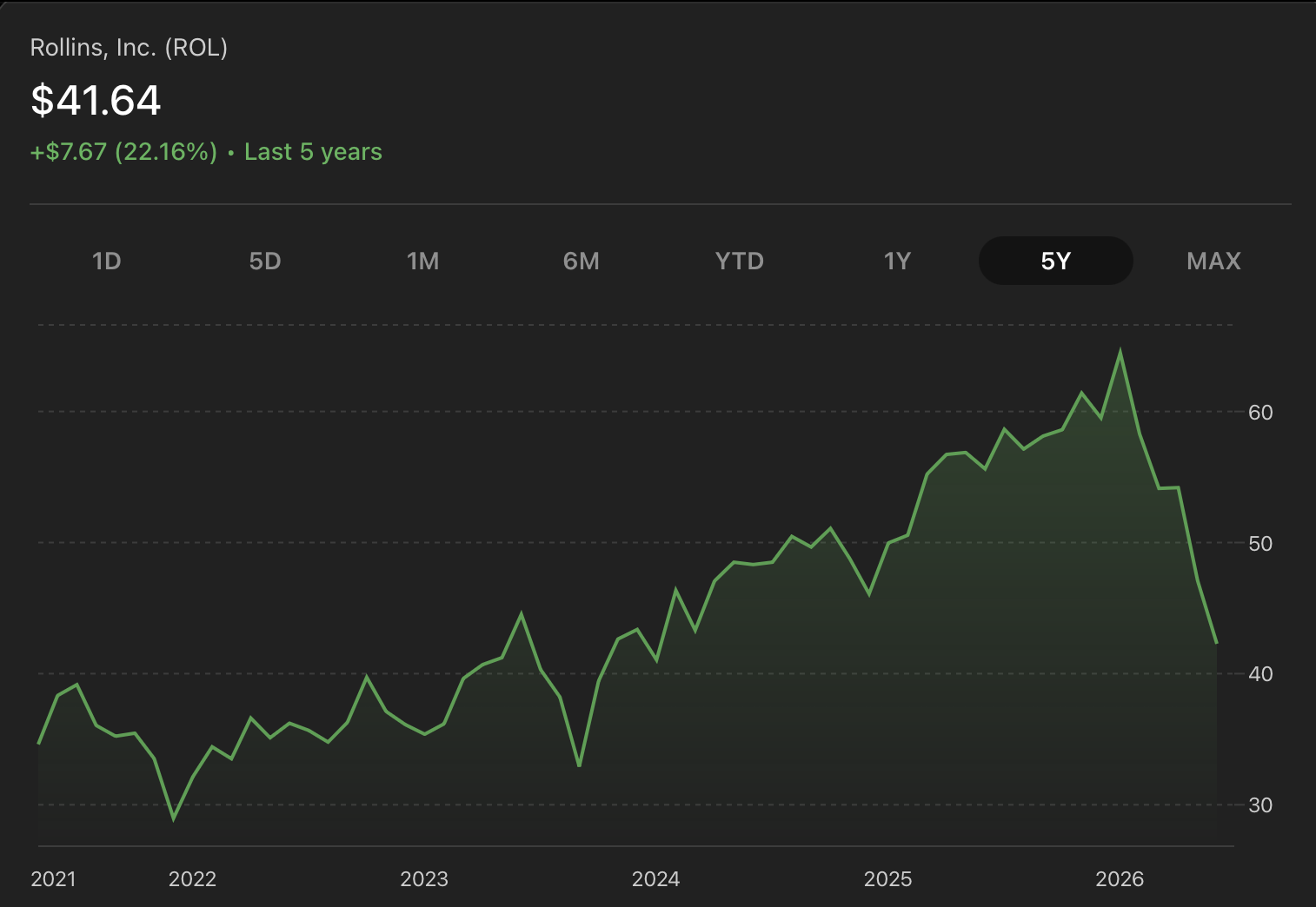
Investment Rating: Watchlist / Potential Long-Term Buy Below Fair Value Range
Current Market View: High-quality compounder trading at a premium valuation
Valuation Framework: 18–25x normalized earnings
Fair Value & Investment Range
| Metric | Estimate |
|---|---|
| Current Share Price | ~$41.59 |
| Current P/E Multiple | ~39x |
| My Fair Value Range | $28–35/share |
| Attractive Buy Zone | $28–32/share |
| High-Conviction Opportunity | <$25/share |
| Valuation Framework | 18–25x normalized earnings |
| Margin of Safety Needed | 20–35% discount to current price |
Investment View:
Rollins is a high-quality compounder that has earned a premium valuation. The question is not whether the company is good — the question is whether the current price already reflects years of future success.
At today’s valuation, investors are paying roughly 40x earnings and over 30x free cash flow. A return to a more reasonable 18–25x earnings range would create a much better risk/reward setup.
Fair Value Uncertainty: Medium
The uncertainty is not the durability of the pest-control business. The main variables are:
- How long the market continues rewarding Rollins with a premium multiple
- Whether acquisitions continue generating attractive returns
- Whether earnings growth can justify the current valuation
Investor Watch Point:
A decline toward the low-$30s would move Rollins from “excellent company at an expensive price” toward a more reasonable long-term investment opportunity.
Investment Snapshot
| Metric | Current View |
|---|---|
| Company | Rollins Inc. (ROL) |
| Business | Pest control services |
| Market Cap | ~$20 billion |
| Current Share Price | ~$41.59 |
| Current P/E | ~39x |
| Forward P/E | ~33x |
| P/FCF | ~32x |
| FCF Yield | ~3.1% |
| Dividend Yield | ~1.8% |
| IV Rank | 89.5% |
| Implied Volatility | 91.8% |
| Value Investor Target Multiple | 18–25x earnings |
| Initial Buy Zone | ~$25–35/share |
Investment Thesis:
Rollins came across my radar as a potential long-term compounder. The company has many characteristics that long-term investors look for: recurring revenue, strong free cash flow generation, pricing power, an asset-light model, and a history of disciplined acquisitions.
The issue is not the business.
The issue is the price.
At nearly 40x earnings and over 30x free cash flow, investors are paying a premium valuation that assumes years of strong execution. For a value-oriented investor, the opportunity becomes more attractive if the market gives investors a chance to purchase this quality business at a more reasonable multiple.
Business Quality: A Classic Compounder
Rollins operates one of the most attractive business models in the service industry.
Pest control has several characteristics that create a durable competitive advantage:
- Recurring customer relationships
- Low customer churn
- Route density advantages
- Local brand strength
- Pricing power
- Consolidation opportunities
Unlike many businesses that require constant reinvestment, Rollins produces strong cash flow with relatively modest capital requirements.
The company has historically used acquisitions as a growth engine, purchasing smaller pest-control operators and integrating them into its platform.
This is exactly the type of business model that attracts long-term investors.
Financial Strength: The Good
Free Cash Flow Machine
Rollins continues to produce strong free cash flow.
Recent quarterly free cash flow:
| Quarter | Free Cash Flow |
|---|---|
| Q1 2026 | $111 million |
| Q4 2025 | $159 million |
| Q3 2025 | $183 million |
| Q2 2025 | $168 million |
| Q1 2025 | $140 million |
The company generated approximately:
$620+ million in annualized free cash flow
This is a strong result for a business with limited capital intensity.
The free cash flow margin has remained consistently in the mid-to-high teens:
- Q1 2026 FCF Margin: 12.3%
- Q4 2025: 17.4%
- Q3 2025: 17.8%
Balance Sheet: The Weakness
The balance sheet is where investors should pay attention.
Rollins has historically been a low-debt business, but acquisitions have increased leverage.
Current balance sheet:
| Metric | Amount |
|---|---|
| Cash | ~$117 million |
| Total Debt | ~$1.07 billion |
| Net Debt | ~$951 million |
| Debt/EBITDA | ~1.25x |
| Net Debt/FCF | ~1.5x |
The leverage is manageable, but the company is no longer operating with the ultra-clean balance sheet investors were accustomed to several years ago.
This does not create a major concern, but it does reduce the margin of safety at an expensive valuation.
Valuation: The Main Problem
The market currently values Rollins as a premium compounder.
Current valuation:
| Metric | Multiple |
|---|---|
| P/E | ~39x |
| Forward P/E | ~33x |
| P/FCF | ~32x |
| EV/EBITDA | ~24x |
Historically, investors have been willing to pay very high multiples for Rollins because of its predictable growth.
However, even great businesses can become poor investments when purchased at excessive valuations.
A 40–50x earnings multiple leaves little room for disappointment.
What Is Rollins Worth?
Using a more conservative value investor framework:
Scenario 1: 25x Earnings (Premium Quality Business)
Assuming normalized earnings:
Estimated fair value:
~$32–35/share
This represents a reasonable price for a high-quality compounder.
Scenario 2: 20x Earnings (More Attractive Entry)
Fair value:
~$28–30/share
This would provide a better margin of safety while still recognizing the company’s quality.
Scenario 3: 18x Earnings (Value Investor Opportunity)
Fair value:
~$25/share
At this price, investors would be buying:
- A strong brand
- Recurring revenue
- Durable cash flows
- A proven acquisition strategy
without paying a premium multiple.
What Price Would Interest Me?
For a long-term investor, Rollins becomes more interesting around:
Watch Zone:
$35/share
At this level, valuation begins moving closer to reasonable.
Attractive Buy Zone:
$28–32/share
This represents roughly:
- 20–25x earnings
- Better risk/reward
- More valuation support
Exceptional Opportunity:
Below $25/share
This would represent the type of valuation that rarely appears in high-quality compounders unless the market experiences fear or a broad selloff.
Additional Metrics Investors Should Watch
Beyond P/E, I would monitor:
1. Free Cash Flow Growth
The investment thesis depends on continued FCF growth.
Watch for:
- Mid-single-digit revenue growth
- Stable margins
- Continued acquisition success
2. Debt Levels
The company’s acquisition strategy works best when leverage remains controlled.
Watch:
- Net Debt/EBITDA below 2x
- Continued cash generation
3. Return on Invested Capital
Current ROIC:
~3.5–5%
This is lower than expected for a company often described as a premium compounder.
The reason:
Acquisition accounting has increased goodwill and intangible assets.
Investors should watch whether acquired businesses generate attractive returns.
4. Insider Ownership and Capital Allocation
Rollins has historically been shareholder friendly through:
- Dividends
- Acquisitions
- Occasional buybacks
The key question:
Are acquisitions creating value or simply increasing size?
Risks
Valuation Risk
The biggest risk is not business deterioration.
It is multiple compression.
A stock trading at 40x earnings can fall significantly even if earnings continue growing.
Example:
A move from:
40x earnings → 25x earnings
could create a large decline without the business actually getting worse.
Acquisition Risk
Rollins relies on acquisitions.
Poor acquisition discipline could reduce returns.
Slower Growth
A mature pest-control business may eventually grow closer to GDP plus pricing rather than the higher growth rates investors currently expect.
Final Takeaway
Rollins is the type of company a long-term investor would love to own.
The business has:
✓ Recurring revenue
✓ Strong cash generation
✓ Durable competitive advantages
✓ Attractive industry dynamics
✓ A history of shareholder value creation
But today’s valuation already reflects much of that quality.
At approximately 40x earnings, investors are paying a premium price for a premium business.
A disciplined investor may want to wait for a better entry point.
Rollins becomes interesting below $35/share, attractive around $28–32/share, and a compelling long-term opportunity below $25/share.
The business is worth owning.
The investment decision comes down to one question:
At what price does a great company become a great investment?
Fair value estimate based on normalized earnings multiples, free cash flow analysis, and margin-of-safety principles. This is not a recommendation to buy or sell securities.