

In trading, “cost of education” isn’t just a phrase—it’s a line item on your tax return.
Recently, I stepped into a Double Calendar Spread on the /ES (S&P 500) during a major volatility spike. The VIX hit 35 on news of “war” in Iran. My thesis? Fear would stay high or escalate. The result? A lesson in how the “Vega Trap” can hollow out a trade even if you get the direction right.
📜 The Trade Log: Entry at the Peak
On March 9, with the VIX screaming at 35, I opened a Double Calendar on the /ESM6 (June 2026 Futures).
| Position | Leg | Expiration | Strike | Price (Entry) |
| Long Put | Bought | 04/17/26 | 6250 | $5,575 |
| Long Call | Bought | 04/17/26 | 6950 | $4,050 |
| Short Put | Sold | 03/23/26 | 6250 | $2,725 |
| Short Call | Sold | 03/23/26 | 6930 | $1,675 |
| Net Debit | $5,225 |
📉 The Collapse: VIX 35 to 22
Within 24 hours, the geopolitical fear subsided. The VIX didn’t just drift—it cratered from 35 to 27, eventually hitting 22.
When volatility collapses this sharply across all expirations (a Parallel Crush), the “Long Vega” nature of the calendar spread becomes its own worst enemy. The back-month options (which I bought for nearly $10k total) lost value at a rate that the front-month options (which I sold) simply couldn’t match.
🧮 The Exit: Math of the “Hollowed Out” Spread
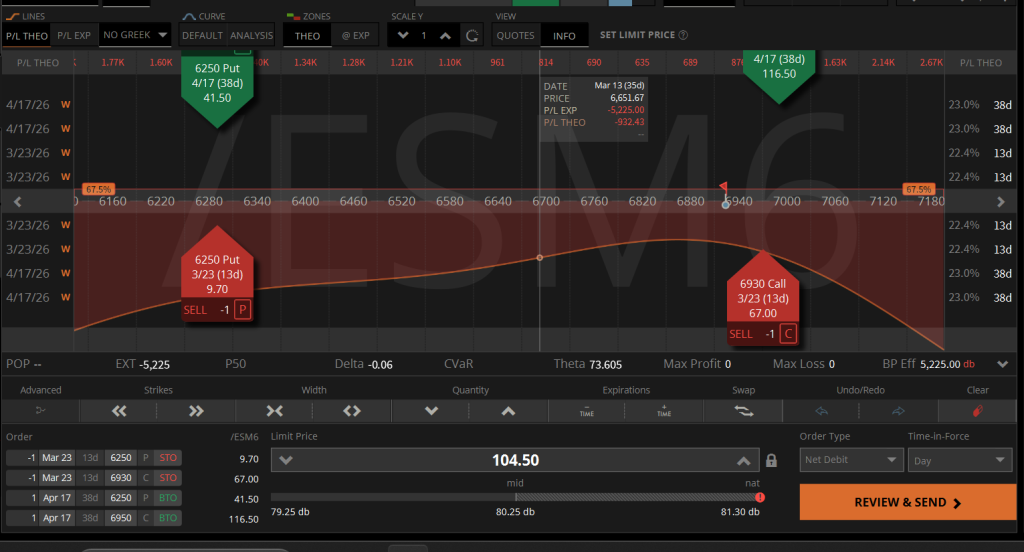
By the time I closed the trade on March 10, the “Profit Tent” had effectively collapsed. Even though the market was relatively stable, the extrinsic value—the “fear premium”—had vanished. When you close a calendar, you are selling your longs and buying back your shorts.
| Position | Price (Exit) | Net Gain/Loss |
| Long Put (4/17) | $2,675.00 (Sold) | -$2,900.00 |
| Long Call (4/17) | $5,100.00 (Sold) | +$1,050.00 |
| Short Put (3/23) | $800.00 (Bought back) | +$1,925.00 |
| Short Call (3/23) | $2,725.00 (Bought back) | -$1,050.00 |
| — | — | — |
| Total Net Credit | $4,250.00 | (Amount returned to account) |
| Total Net P&L | -$975.00 | (Excluding commissions/fees) |
The Lesson: My back-month Put alone lost $2,900 in value. The gain on my short Put ($1,925) wasn’t even close to offsetting it. Because I was Long Vega, the VIX dropping 13 points created a hole that Theta (time decay) would have needed weeks—not days—to fill.
🧠 Strategic Post-Mortem: Why There Was No Recovery
- Buying the “Ceiling”: Entering at VIX 35 is a bet that the world will stay in crisis. If things “return to normal,” you are holding the most expensive insurance possible at the exact moment people stop being afraid.
- The Theta Race: To recover that $975 loss through time decay alone, the market would have had to sit perfectly still for nearly two weeks. But in two weeks, the Greeks change, and the 15-day short options would have already expired.
- The “Shrinking Tent”: At VIX 35, my breakevens were wide. At VIX 22, the “walls” of the profit tent pulled in so tightly that the trade was underwater before the price even moved.
💡 Final Educational Takeaway
Calendar spreads are sold as “income” trades, but at high VIX levels, they are Volatility Bets. If you think VIX has peaked, stay away from calendars. You are buying a depreciating asset (Vega) into a wall of selling.
Instead, wait for the “Moderate VIX” environment (VIX 18–24) where a spike helps you, or look for structures like Ratio Spreads that actually profit when volatility deflates.
Leave a Reply