One of the most common questions short options traders face is whether they should be purely systematic (signal-based) or entirely discretionary. Recently, someone in one of my trading communities asked me exactly that: “Is it all discretionary, or is it signal-based?”
It’s a fundamental question because selling options inherently involves managing constant exposure to time decay and market volatility. If you don’t find the right balance, a highly structured trading plan can easily turn into a high-stress, exhausting chore.
For years, I was firmly in the systematic camp. In the options world, this is often called the “Tastytrade” school of thought, a purely mechanical, probability-driven approach where you let the math do the heavy lifting, place high trade occurrences, and largely ignore where the stock is going. On the other side of the fence is the charting school, where traders live by technical analysis, support and resistance levels, and capturing the emotional sentiment of the market.
I traded incredibly methodically, leaning heavily on hard statistics, complex technical indicators, and strict entry signals. And you know what? It worked. The math held up, and the trades made money.
But there was a hidden cost: stress.
Chasing every signal led to overtrading, screen fatigue, and eventually, careless mistakes. The process was taking far more from my peace of mind than it was giving back in financial returns. I realized that to survive, and actually enjoy, this game long-term, I needed to simplify.
Today, my trading sits in a highly deliberate “sweet spot” between these two worlds. I use discretionary, sentiment-based timing for my entries, and strict, mechanical rules for my exits. Here is exactly how I blend the two to keep my trading profitable, low-stress, and aligned with my life goals.
The Hybrid Model: Where Discretion Meets Rules
I don’t believe you have to be 100% mechanical or 100% discretionary. Instead, I separate my trading into two phases: discretionary entries and strictly systematic exits.
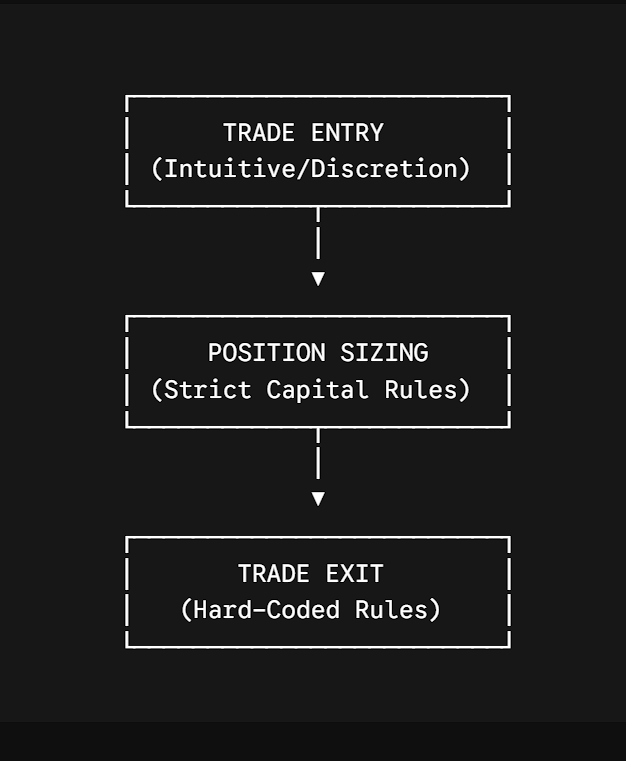
1. Discretionary Entries (Following the Flow)
Instead of trying to outsmart the market with complex algorithms, I spend my time watching where institutional money is flowing. My entries rely on market rhythm rather than rigid triggers:
- Buying the Pullbacks: I actively welcome market pullbacks. That is when I am most willing to allocate capital and load up on high-probability trades.
- The Mid-Week Routine: If the market doesn’t give me a clear pullback but I have idle capital burning a hole in my pocket, I look to establish positions on Wednesdays around noon. It’s a natural weekly inflection point where market direction often stabilizes.
- Minimalist Technicals: I don’t use 15 different indicators. I glance at the 10-, 20-, and 30-day moving averages just to get a general sense of direction. It’s more of a personal “voodoo tea-leaf reading” to gauge momentum than a hard entry signal.
2. Systematic Exits (Eliminating Human Emotion)
While my entries have a touch of art to them, my exits are pure, unyielding science. Once a trade is live, the thinking stops. The rules take over:
My Exit Formula:
- Take Profit: Automatically set at 50% of maximum credit.
- Stop Loss: Strictly defined at 2x the premium collected (unless, of course, I’m being a dumbass and not paying attention!).
By automating the exit, I take the most emotionally charged part of trading completely out of my hands. I don’t have to wonder “will it bounce?” or “should I squeeze out a few more dollars?” The bracket orders do the work.
The Illusion of Math: Why Purely Quantitative Trading Can Fail
It sounds so clean in a textbook: sell an Out-of-the-Money (OTM) option, collect your premium, and let the high probability of success do the work.
I’ve had this exact debate with engineers who trade. Many are drawn to options trading because they love the mathematical and structural logic of it. The problem is that many engineer-type traders become incredibly rigid in their thinking. They assume the market is a passive, neutral laboratory where their statistical models can run undisturbed.
They ignore market psychology, which is a very real, living force. When panic hits, those statistical models have zero control because the underlying plumbing of the market is actively controlled by market makers who are “setting the stage.”
The dirty secret of the purely quantitative approach is that it works beautifully until it doesn’t. Options trading exhibits “negative skew”—meaning you win small most of the time but lose big when you lose. A single, unhedged Black Swan event can wipe out a year’s worth of pristine, systematic profits in ten minutes.
When a true crisis hits, systemic issues destroy the rigid mathematical models.
1. The Myth of the Exit: Liquidity Evaporation
The quantitative model assumes that you can easily buy back your short option at your 2x stop-loss.
In a flash crash or panic, liquidity vanishes. Market makers, the institutions who provide the “bid” and the “ask” prices, will instantly widen their spreads to protect themselves. They are the ones setting the stage, and they will happily reprice your options out of existence to keep themselves solvent.
If you sell a put for $1.00, expecting to buy it back at $3.00 if things go south, you might find that during a sudden market drop, the bid-ask spread on your contract balloons to a massive $4.00–$12.00. Suddenly, even if the “fair value” of your option is only $3.00, the absolute cheapest price you can physically execute a trade to close your position is $12.00. You are entirely at the mercy of the market makers, and your systematic stop-loss is blown past.
2. Technical Glitches and “Flash Crashes”
No matter how good your strategy is, you are at the mercy of the physical infrastructure of the exchanges. When the plumbing breaks, systematic models fail instantly.
During the infamous May 6, 2010 Flash Crash, high-frequency trading programs withdrew from the market en masse after an automated algorithm triggered a rapid sell-off. In a matter of minutes, liquidity evaporated completely. Blue-chip giants like Accenture plummeted from nearly $40 all the way down to one cent per share before rebounding.
If you were a short options trader running automated risk parameters, your system registered a 100% loss and happily triggered automatic, catastrophic liquidations at the absolute bottom of the market.
3. SPAN Margin and the Futures Liquidity Trap
If you want a historic case study on how rigid mathematical models implode, look no further than Volmageddon on February 5, 2018. It wasn’t just a market drop; it was a total breakdown of market plumbing.
When automated volatility products were forced to rapidly buy back VIX futures to rebalance, they hit a wall. Market makers pulled their quotes, causing bid-ask spreads in the futures market to widen to catastrophic levels. Because the underlying futures market froze, options market makers couldn’t hedge, so they stopped quoting fair prices entirely. If you tried to buy to close your short options to save your account, you were locked out.
Worse yet, this chaos triggered SPAN (Standard Portfolio Analysis of Risk) margin expansion. The clearinghouse risk algorithms automatically calculated that the market was in unprecedented danger and instantly multiplied margin requirements by 500% or more.
Traders who held options that were technically safe and out-of-the-money suddenly woke up to massive margin calls. Brokerage risk bots didn’t wait for a human response; they forcefully liquidated these accounts, dumping positions into an illiquid market with massive bid-ask spreads. Traders following strict quantitative rules were caught up in this, their statistical models had no control over this panic because the house shifted the rules. They were wiped out at the absolute bottom, losing years of systematic gains in minutes simply because a computer script took over their account.
The AI Trap: Replacing Screen Time with “Bot Sitting”
Lately, there’s a massive trend promising to solve these stress points: deploying AI trading bots. The promise of automation sounds incredibly clean—just plug an intelligent agent into your broker terminal and let it trade.
But ask the retail traders who actually run these systems, and they’ll tell you the cold reality: nobody is just letting these bots run wild.
Most of the actual trading occurs during normal market hours when volume, volatility, and liquidity are at their peak. Because of that, you can’t just walk away. Even bots react heavily to market sentiment, and because they lack true human context, they can and do go completely off the rails or fall victim to protocol glitches during unprecedented market events.
To prevent catastrophic losses, traders have to actively hand-hold their bots throughout the trading day. They are constantly monitoring API connections, checking fill quality, and ensuring the algorithms don’t hallucinate a trend.
Even though the technology makes the execution easier, if you are a day trader relying on automated systems, you are still glued to your screen all day. You haven’t bought your time back; you’ve just traded manual execution for the high-stress job of baby-sitting a volatile piece of code.
If that rigid, hyper-technical style works for some people, great. But that is not how I trade, nor is it how I want to spend my life.
Following the Money: The Art of Charting Sentiment
I would much rather trade based on human market sentiment, whether I am trading against the bots or alongside them.
Being a highly visual person, it is much easier and more intuitive for me to look at a chart and physically see the money movement. When you look at price action, you are looking at the footprint of institutional capital.
Statistically speaking, the trading bots are technically following these exact same structural movements. The difference is that a bot sees it as a rigid, binary “yes or no” equation. To me, reading a chart is an art form. It requires interpreting the mood, the momentum, and the flow of the market, nuances that a line of code simply cannot feel.
The Delusion of Code-Based “Emotion”

I recently got into a debate with an engineer about this. He confidently argued that he could build an AI model to fully map, predict, and trade human emotion in the market.
Honestly, debating this was a complete waste of time. Folks with that hyper-rational mindset are often blind to the fallacy in their own thinking. They truly believe that computers and human-made algorithms are always smarter than people. and that any human element can eventually be reduced to a clean line of code.
My response to him was simple: “Good luck with that.”
The stock market is not a math problem to be solved; it is a giant, chaotic psychological battlefield driven by fear, greed, panic, and pride. You cannot program a computer to perfectly anticipate the behavioral madness of crowds because human emotion isn’t logical. Even if you write an algorithm to track sentiment metrics, the program itself lacks the intuitive “gut check” needed to survive when the herd panics.
By using my own eyes and years of hard-won experience to gauge market sentiment visually, I can wait for the perfect structural pullback to enter a trade. I drop the anchor exactly when fear has pushed premium to its peak, an organic timing mechanism that rigid models can never quite replicate.
I know the high-tech, high-stress trap intimately because I used to do exactly that. I spent years staring at charts all day, managing complex systems, and letting the market dictate my calendar. Today, I’ve replaced all that noise with simple, high-probability setups, allowing me to spend at most 2 hours a week trading.
Capital Allocation and Core Holdings
Simplifying my trading also meant streamlining what I trade and how I research. Today, I don’t scan hundreds of volatile penny stocks. Instead, I focus my energy where the liquidity and efficiency are highest, spending only about 10 to 20 minutes a week going over my list of stocks to determine overall market sentiment and to look for long-term value trades that may cross my radar.
- The Bread and Butter: The vast majority of my trading profits come from trading options on the SPX (S&P 500 Index) and /ES (E-mini S&P 500 futures). They offer superb liquidity, tax efficiencies, and highly predictable options pricing.
- The Cash Cache: I never let idle trading capital sit around doing nothing. Any cash not actively deployed in margin is parked in SGOV (iShares 0-3 Month Treasury Bond ETF) to safely harvest yield—currently yielding a solid 3.57%.
- Long-Term Value Investments: When those brief weekly check-ins yield a long-term value play, I lean on modern AI tools to speed up my fundamental research, looking deeper into the equity than traditional SEC filings alone allow. For instance, I’m currently holding a core position of 800 shares of Lyft, which I acquired around $12 as a long-term value hold (which has since climbed nicely to the $15–$16 range).
Trading to Live, Not Living to Trade
At this stage in my journey, I have zero desire to build a massive trading empire. I’m retired.
My trading capital isn’t there to make me a billionaire; it’s there to generate supplemental cash flow alongside my pension and Social Security. That extra income funds what truly matters to me: traveling the world, exploring new countries, and connecting with people from different backgrounds.
By utilizing discretionary timing based on visual money flow, and keeping my exits completely automated through basic, unglamorous broker bracket orders, I get the absolute best of both worlds. I protect myself from the exact systemic glitches and rigid thinking that destroy purely mechanical traders, and I get the freedom to actually enjoy my life with the people I love.