
Investment Rating:
BUY (High-Conviction Value Opportunity)
The Verdict:
At less than 5 times free cash flow and with a tax-free spin-off of NBCUniversal on the horizon, Comcast is one of the most asymmetric large-cap opportunities in the market today.
Current Market View:
The market is treating Comcast like a dying copper-cable utility, completely discounting its massive broadband moat and the enormous value of its theme parks, streaming, and content assets.
Valuation Framework:
7.0-9.0x normalized Owner Earnings (or a 11.0% to 14.3% FCF Yield).
Fair Value & Investment Range
| Metric | Estimate |
| Current Share Price | ~ $24.55 |
| Current P/E Multiple | ~ 4.79x |
| My Fair Value Range | $38.00 – $48.00/share |
| Attractive Buy Zone | $25.00 – $32.00/share |
| High-Conviction Opportunity | Below $25.00/share |
| Valuation Framework | 7.0-9.0x normalized Owner Earnings |
| Margin of Safety Needed | 35-45% discount to Fair Value |
Investment View
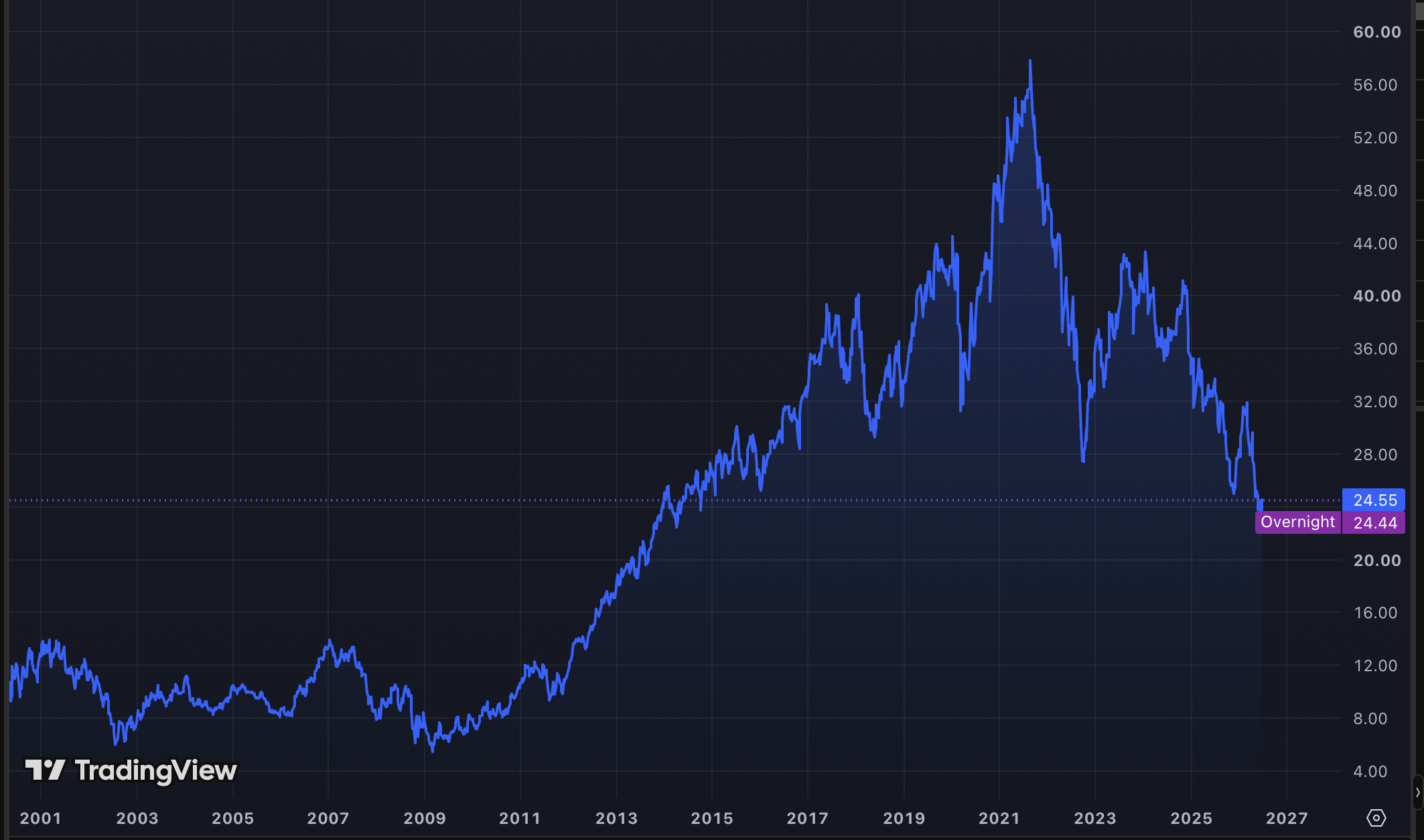
We are looking at an unusual pricing anomaly of historic proportions. The market has spent the first half of 2026 punishing the entire cable sector following a severe earnings-driven collapse at Charter Communications, dragging Comcast down to an absurdly compressed valuation of $24.55 per share. Yet, Comcast is not Charter; it is a cash-compounding juggernaut that just generated over $20.00 billion in trailing free cash flow.
The question is not whether the company is good — the question is whether the current price offers an equity coupon rate high enough to satisfy a disciplined value investor. At today’s price, Comcast is offering an implied Owner Earnings Yield of 23.2%. This is a valuation level usually reserved for businesses in terminal, rapid decline, which is a flat-out mischaracterization of Comcast’s underlying assets.
With the dramatic announcement on June 29, 2026, that Comcast will spin off NBCUniversal and Sky into a standalone, tax-free public company, the catalyst to unlock this value is now officially in motion. Investors will soon own two pure-play market leaders: a highly predictable, high-margin connectivity giant and an agile, world-class media and theme parks powerhouse.
Fair Value Uncertainty
Fair Value Uncertainty: Medium
The uncertainty is not primarily about:
- Business durability: The physical coaxial and fiber network infrastructure in place across 65 million homes is nearly impossible to replicate.
- Competitive position: High-speed broadband remains a non-discretionary utility for the modern household.
- Revenue stability: Contractual, recurring monthly subscription revenues protect Comcast’s cash inflows from economic downturns.
The main variables are:
- Broadband subscriber net migration rates as Comcast navigates intense competition from fixed wireless and fiber overbuilders.
- The execution and tax-free status of the NBCUniversal / Sky spin-off over the next 12 months.
- Post-spin capital allocation and leverage levels of the standalone connectivity business.
Investor Watch Point
The ultimate game-changer is the timeline and regulatory progress of the NBCUniversal spin-off. Any regulatory roadblocks or unexpected tax friction that threatens the tax-free distribution of NBCU shares to Comcast equity holders would alter the immediate thesis, while a stabilization of domestic broadband subscriber losses (which stood at 65,000 in Q1 2026) will likely trigger an aggressive upward re-rating of the stock.
Investment Snapshot
| Metric | Current View |
| Company | Comcast Corporation (CMCSA) |
| Business Description | A global media and technology giant transitioning into a pure-play connectivity provider (broadband/wireless) and a separate media/parks powerhouse (NBCUniversal). |
| Market Cap | ~ $87.70 billion |
| Current Share Price | ~ $24.55 |
| Current P/E | 4.79x |
| Forward P/E | 6.96x |
| P/Owner Earnings (P/FCF) | 4.30x |
| Owner Earnings Yield | 23.2% |
| Dividend Yield | 5.38% |
| IV Rank | 91.7% |
| Implied Volatility | 100.0% |
| Wall Street Consensus Target | $42.00 (Sentiment: Neutral) |
| Value Investor Target Multiple | 7.0-9.0x Owner Earnings |
| Initial Buy Zone | $25.00 – $32.00/share |
Investment Thesis
Comcast came across my radar because of a massive market-driven sector panic that has completely disconnected the stock’s price from its structural cash generation. The options market is currently experiencing extreme fireworks, with Implied Volatility at 100% and an IV Rank of 91.7%. This massive spike is the direct result of the June 29, 2026, announcement of the NBCUniversal and Sky split, which has forced short-term traders to scramble.
Mainstream analysts have locked onto the short-term panic of minor broadband subscriber losses and rising programming costs, completely ignoring the absolute cash machine under the hood. For a disciplined value investor, this structural distress represents the perfect storm. We can acquire a dominant infrastructure moat at a mid-single-digit cash multiple, while receiving a 5.38% dividend yield and a free options ticket on a massive corporate break-up.
Business Quality: The Broadband Toll Road and the Media Machine
Comcast’s business quality rests on two distinct, highly valuable pillars that are structurally guaranteed to remain relevant for decades.
Simple and Understandable: The connectivity division functions as a literal toll road for the internet. Whether consumers are streaming movies, working from home, or playing games, they must pay Comcast a recurring monthly fee to access the digital world.
Durable Economic Moat: The economic moat is built on massive capital-intensive switching costs. While wireless competitors have made marginal progress, high-speed physical wireline broadband remains the gold standard for reliable home connectivity. The career risk of a remote worker switching to an unstable internet alternative ensures Comcast’s core subscriber base remains sticky.
High Returns on Invested Capital (ROIC): While the physical cable network required immense historical capital to build, it is now in a harvesting phase. Maintenance capital expenditures are highly manageable, allowing the core connectivity business to convert an extraordinary percentage of its operating profits directly into free cash flow.
Financial Strength: The Good
Revenue Growth
Comcast has demonstrated remarkable top-line resilience. Despite secular headwind pressures on traditional cable TV, consolidated revenue for Q1 2026 grew 5.3% year-over-year to $31.46 billion. This top-line stability is driven by strong pricing power in broadband and rapid expansion in domestic wireless lines, which grew by an impressive 435,000 in the first quarter of 2026 alone.
Free Cash Flow & Owner Earnings Machine
To find the true economic reality of Comcast, we strip away accounting adjustments and look directly at Owner Earnings.
Owner Earnings = Net Income + Depreciation & Amortization – Capital Expenditures
Trailing 4 Quarters Cash Generation
| Quarter | Free Cash Flow (Net Income + D&A – CapEx + adjustments) |
| Q1 2026 | $4,540.00 million |
| Q4 2025 | $5,084.00 million |
| Q3 2025 | $5,622.00 million |
| Q2 2025 | $5,136.00 million |
The company generated approximately: $20,382.00 million ($20.38 billion) in trailing annualized Owner Earnings. This level of cash generation represents an incredible FCF margin of 16.2% on consolidated revenues, highlighting the business’s immense capital efficiency.
Balance Sheet: The Strength
| Metric | Amount |
| Cash | ~ $9,468.00 million |
| Total Debt | ~ $94,612.00 million |
| Net Debt | ~ $85,144.00 million |
| Debt/EBITDA | 2.68x |
| Net Debt/Owner Earnings | 4.18x |
While a total debt load of $94.61 billion looks intimidating at first glance, it must be evaluated in context. Comcast possesses an investment-grade balance sheet with highly predictable utility-like cash flows. Furthermore, the company’s negative tangible book value is not a sign of distress; it is an accounting distortion caused by billions of dollars in aggressive, highly accretive historical share repurchases that have retired over 4% of the shares outstanding in the last year alone.
Valuation: The Main Opportunity
| Metric | Multiple |
| P/E Ratio | 4.79x |
| Forward P/E | 6.96x |
| Price / Owner Earnings | 4.30x |
| EV / EBITDA | 4.89x |
The market is pricing Comcast as if its business model is about to drive off a cliff. This is a classic value-investing setup where short-term career risk has forced professional mutual fund managers to dump cable equities to protect their quarterly performance reviews. By taking the other side of this trade, we are purchasing a premier asset at an unprecedented discount.
What Is The Company Worth?
Using the concept of a coupon-paying equity bond, let us map out three realistic scenarios for Comcast’s intrinsic value.
Scenario 1: Premium Quality Business (Optimistic Base)
- Assumptions: Post-split, the market fully values Comcast’s pure-play telecom network at 8.5x Owner Earnings, and NBCUniversal commands a premium media multiple of 12.0x.
- Estimated Fair Value: $49.00 – $60.00/share
- Explanation: When the media division is valued alongside peers like Disney, the combined sum-of-the-parts valuation represents an obvious and rapid upward correction.
Scenario 2: Attractive Entry (Conservative / Mid-Cycle)
- Assumptions: The business splits successfully, and Comcast trades at a highly conservative blended multiple of 7.0x to 9.0x normalized trailing Owner Earnings.
- Estimated Fair Value: $38.00 – $48.00/share
- Explanation: This represents our baseline expectation. It assumes very little growth but corrects the current absurdly compressed 4.3x FCF valuation.
Scenario 3: Value Investor Opportunity (Pessimistic / Cyclical Bottom)
- Assumptions: High competition persists in broadband, and the spin-off experiences minor execution delays, keeping the blended multiple compressed at 4.5x to 5.5x FCF.
- Estimated Fair Value: $25.00 – $32.00/share
- Explanation: Even under severe operational stress, the downside is highly insulated by the 5.38% dividend yield and massive ongoing stock buybacks.
What Price Would Interest Me?
Watch Zone:
$33.00/share
At this price, the stock begins to look interesting, offering an implied FCF yield of approximately 16.8%.
Attractive Buy Zone:
$25.00 – $32.00/share
This range offers an immense margin of safety. Purchases made here capture a double-digit FCF yield and position investors beautifully to benefit from the corporate spin-off unlock.
Exceptional Opportunity:
Below $25.00/share
At $24.55, we are in the sweet spot. The risk of permanent capital loss at this entry point is extremely remote, while the potential for significant capital appreciation is highly asymmetric.
Additional Metrics Investors Should Watch
- Owner Earnings Growth: Pay close attention to sequential cash collection stability, especially post-spin.
- Return on Invested Capital (ROIC): Track whether capital deployment efficiency remains high as the connectivity company streamlines its operations.
- Capital Allocation (Buyback Yield): Watch the pace of share retirements; at current prices, Comcast’s share repurchases are massively value-accretive to remaining shareholders.
- Contract/Subscription Health: Track the rate of customer relationships, specifically domestic wireless net additions.
Risks
- Valuation Risk: If the market enters a prolonged downturn, Comcast’s multiple could remain compressed regardless of its strong fundamental cash flow.
- Business/Moat Risk: Acceleration in residential broadband losses due to fixed wireless overbuilds could structurally lower the long-term cash generation baseline.
- Capital Allocation Risk: There is a risk that management over-allocates capital to expensive content acquisitions or aggressive international expansion pre-split rather than continuing to pay down debt and retire undervalued stock.
Final Takeaway
Comcast is the type of company a long-term investor would love to own.
The business has:
- [x] Competitive advantages (Unreplicated physical broadband network infrastructure)
- [x] Strong cash generation (Durable, highly predictable trailing Owner Earnings of $20.38B)
- [x] Durable business model (Essential monthly utility billing with high customer retention)
- [x] Attractive industry position (An effective broadband duopoly in major U.S. markets)
But today’s valuation determines whether it is a good investment.
A great company does not always make a great investment at any price.
The opportunity comes when the market offers a price that provides an adequate margin of safety.
Fair value estimate based on normalized earnings multiples, Owner Earnings analysis, and margin-of-safety principles. This is not a recommendation to buy or sell securities.