
Strategy Source
Creator: Tom King Published Date: Jun 16, 2023 Link: How to Trade the 112 Strategy
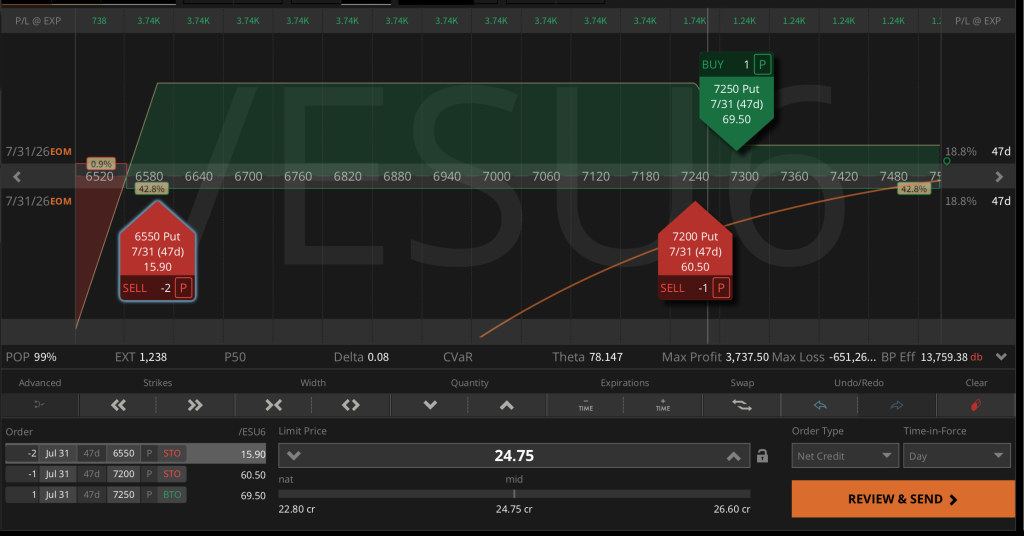
Trade Setup
The “112” strategy is a mechanical, credit-based income trade. It follows the same foundation as the 111, but instead of one naked put, you sell two. This structural change allows for a wider trap and greater downside protection while collecting similar credit.
| Action (Sell (-)/Buy (+)) | Leg | DTE | Strike Price / Delta Target | Width |
|---|---|---|---|---|
| Buy (+) | Long Put | ~60 | ~25 Delta | Variable |
| Sell (-) | Short Put | ~60 | ~25 Delta + 50 points | 50 |
| Sell (-) | Naked Put (x2) | ~60 | ~5 Delta | N/A |
- Total Capital Required: Margin requirement varies by underlying. The creator caps risk at 2% of total portfolio value per trade and limits strategy allocation to 30% of total available buying power.
- Execution Context: The video demonstrates theoretical setup and backtesting on the tastytrade platform using ES Futures.
Strategy Application
This strategy is an income generator that provides a semi-hedge during market pullbacks.
- Strike Selection: The creator uses mechanical rules rather than subjective analysis:
- Put Debit Spread (The “1-1”): Aim for a ~25 Delta long put. For ES Futures, use a 50-wide spread to collect $7–$8 in debit.
- Naked Puts (The “2”): Sell two puts at approximately the 5 Delta strike. The goal is to collect $10–$12 in credit, resulting in a net credit for the entire trade (e.g., $12.50 net credit).
- Buffer Zone: By using two puts at the 5 Delta level, the structure creates a significant “trap.” In the ES example provided, the naked puts were placed ~14% below the current market price, providing a substantial downside cushion.
- Time Differential: The creator prefers ~60 DTE. This longer duration maximizes premium collection and minimizes the negative impact of Gamma (accelerated risk near expiration).
Risk Profile
- The Greeks:
- Delta: The trade starts with a slight positive Delta. It is designed to profit from neutral-to-bullish moves, but performs better if the market drifts lower into the “trap.”
- Theta: A positive Theta trade that benefits from the daily erosion of time value.
- Vega: Negative Vega. A spike in implied volatility will inflate the value of the short naked puts, hurting the trade’s mark-to-market value.
- Gamma: Risk is managed by being far out in time (60 DTE), but a rapid, hard sell-off can cause a temporary loss due to Gamma expansion.
- Assignment Risk: The naked puts carry assignment risk. The creator views this as an opportunity to acquire the underlying at a 15–20% discount.
- Capital Preservation: Never risk more than 2% of the portfolio on a single trade’s max loss.
Expected Outcome
1. The “Tail” (Base Win)
If the market stays flat or rallies, the trade expires in the “tail.” You keep the entire net credit collected at entry. The creator targets an ~8% return on margin per 60-day cycle.
2. The “Trap” (Max Profit Zone)
If the market sells off and settles within the “trap” (between the short put spread and the naked puts), you keep the initial credit plus the full value of the put debit spread. This can result in a 20–30% return if realized.
Management & Exit Triggers:
- Primary Target: Let the trade expire worthless in the “tail” or exit near the trap with a few days left to avoid assignment risk.
- Naked Put Adjustment: Close the naked puts once they reach 95% of their maximum profit potential, leaving the put debit spread as a “free” hedge.
- Strangle Adjustment: If the market rallies hard within the first two weeks, consider selling two naked calls (creating a 1122 structure) to capture additional income, managing those calls as a separate trade.
- Defensive Stop Loss: Close the entire position if the loss equals 1x the maximum profit potential of the trade.
- Rolling: With 7 DTE, you can roll the long put down by 50% of the trap’s width to ensure continued credit and maintain a defensive posture.