
Source: Produced by Theta Profits – Zohed Noormohamad (Dec 14, 2025)
Original Title: This Options Strategy Can Deliver 60% Returns – Here’s Why
1. Strategy Overview
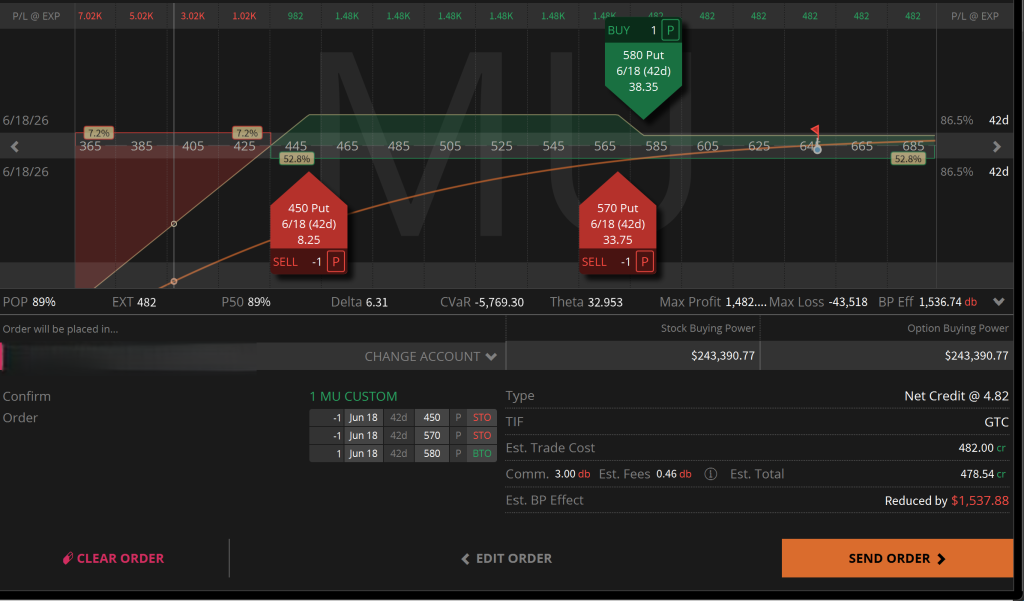
The 111 Strategy is an undefined-risk options play designed to generate consistent income with a high probability of profit (85%–90%+). It functions as a Put (or Call) Credit Spread where a portion of the credit is used to purchase a Debit Spread, creating a “trap” where profits can exceed the initial credit if the underlying asset moves against you slightly.
- Primary Goal: Capture theta (time decay) while maintaining a hedge against moderate moves.
- Performance Goal: Approximately 60% return on buying power used or 30% annually on the total account.
- Market Sentiment: Versatile; works in bullish, bearish, or neutral environments.
2. Trade Setup & Entry Criteria
Underlying Selection
- Liquidity: Minimum 5,000 contracts traded daily to ensure tight bid/ask spreads.
- Volatility: High IV Rank (30+) is preferred to capture higher premiums.
- Technical Confirmation: RSI overbought or oversold (Daily/Weekly) acts as a bonus confirmation for directional assumptions.
The Mechanics (3 Legs)
- Leg 1 (Long Put/Call): Buy 1 at approximately 30 Delta.
- Leg 2 (Short Put/Call): Sell 1 to create a $5–$10 wide debit spread.
- Leg 3 (Short Put/Call): Sell 1 further out-of-the-money (OTM) at approximately 20 Delta (or 15 Delta in high IV).
Entry Parameters
- DTE (Days to Expiration): 45–60 days (Monthly cycles only).
- Target Credit: Aim for $2.00 per contract ($200 net credit).
- Strike Distance: The financing short strike should ideally be 20% away from the current price.
3. The “Trap” Area & The Call Side Advantage
The 111 structure creates a unique profit profile:
- The Trap: If the stock moves into your debit spread, your profit is Initial Credit + Width of Debit Spread.
- The Call Side: While often used as a put strategy, it is highly effective on the call side. Calls are often easier to manage because “markets don’t crash up,” and high-volatility tickers often have favorable call skew.
4. Trade Management (The Rules)
Exit Rules
- Take Profit: Close the trade at 50% of the initial credit.
- The 21-Day Rule: If 50% profit is not hit by 21 DTE, close or roll the position. This is the “hard stop” to avoid the exponential increase in Gamma (price sensitivity).
Defensive Management (The Rolling Masterclass)
If the trade is challenged at 21 DTE, you are entering a “Campaign.” The goal is to accumulate credit over multiple cycles until you exit for a profit.
| Method | Action | When to Use |
| Standard Roll | Close the 111; reopen a new 111 further OTM. | To maintain the “trap” protection. |
| The Naked Roll | Close the debit spread for profit; roll only the short leg. | Preferred. Easiest to manage and speeds up recovery. |
| The Double Naked | Close long leg; roll two short legs. | To maximize credit and widen breakeven; requires higher margin. |
| Extreme Safety | Roll legs significantly further OTM. | For high-conviction defense; results in lower profit potential. |
5. Risk & Workflow Efficiency
- Risk Rating: For experienced traders, this is a 2–3 out of 10 risk, provided the 21 DTE rule is followed. For beginners, it is a 5–6 out of 10 due to the psychological nature of undefined risk.
- Time Commitment: Once your scanner is configured, finding and executing a trade takes roughly 10 minutes.
- The Golden Rule: “Trade Small.” Keep position sizes low enough to allow for rolling during a total market downturn.
Execution Tip: Use a tool like Option Samurai to scan for $2.00+ premium opportunities and Option Strat to visualize the “trap” and breakeven points before entering the trade on your brokerage platform.