
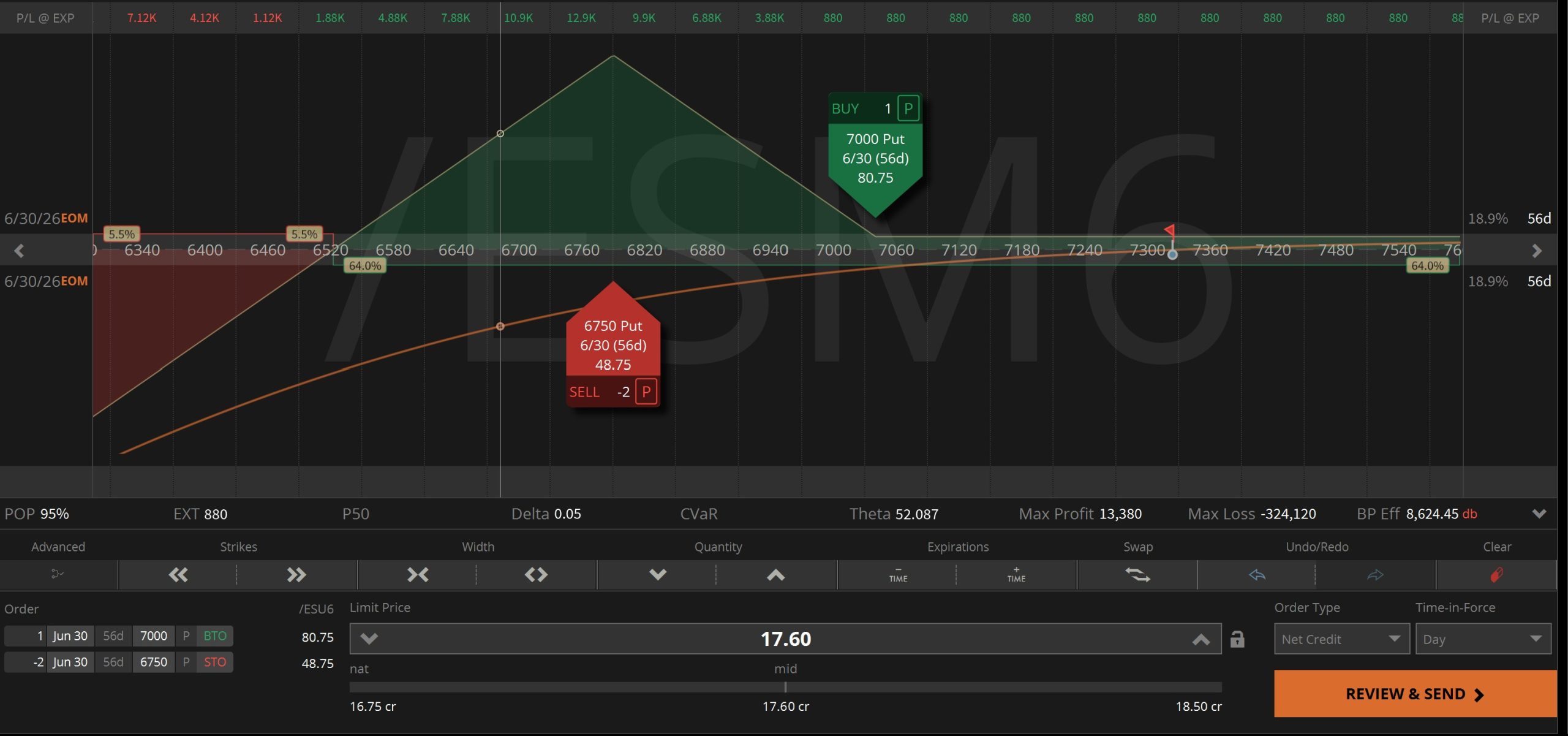
A high-probability income trade taught by Uncle Tony. Strategy, entry rules, sizing, and adjustment mechanics — all in one place.
Source: My Favorite Trade Revealed | The 1-2-0 | Tony is Trading
What is the 1-2-0?
| Component | Action | Purpose |
|---|---|---|
| Long put (1) | Buy 1 higher strike put | Protection wall + profit engine on slow move down |
| Short puts (2) | Sell 2 lower strike puts | Income generation — funds the long put and creates a credit |
| Net result | Credit received | You are paid to enter the trade |
Key idea: The long put acts as a “tsunami wall” — if the market crashes, it explodes in value and partially offsets losses on the two short puts. You get more protection than a naked put alone, while still collecting premium.
Instruments & sizing
| Instrument | Relative size | Capital required | Max profit | Target credit |
|---|---|---|---|---|
| SPX | Full | ~$70,000 | ~$11,000 | $15–$20 |
| ES (E-mini) | ½ of SPX | ~$11,000 Most efficient | ~$5,800 | $15–$20 |
| SPY | 1/10 of SPX | ~$7,000 | ~$1,100 | $1.00–$2.00 |
| MES (Micro) | 1/50 of SPX | ~$720 | ~$585 | $0.15–$0.20 |
Why ES stands out: ES uses SPAN futures margining, requiring only ~$11K capital vs $70K for SPX — for roughly similar risk-adjusted exposure. Tony considers ES the sweet spot for capital efficiency. Note: futures trade 24 hours, giving you more flexibility to manage.
Entry checklist
- Expiration: Target 45–60 DTE. Prefer monthly expirations for better liquidity and orderly management. Further out = more premium = more conservative.
- Long put strike: Find the ~25 delta put. This is your anchor. Round numbers are fine — close enough matters more than precise delta.
- Short put placement: Sell 2 puts that are beyond the expected move — outside 1 standard deviation. Aim for roughly 100 SPX points (or 10 SPY points) below the long put.
- Credit target: Collect $15–$20 on SPX / $1.00–$2.00 on SPY. Note: SPY credit does not scale as a clean 10:1 from SPX — volatility skew and liquidity affect real fills.
- Greeks check: Probability of profit ~92% · Theta positive · Extrinsic value positive
- Breakeven buffer: Confirm your downside breakeven is roughly 6–7% below the current market. The SPX example showed ~6.5% protection before hitting max loss.
SPX example trade
| Leg | Action | Strike | Price | Notes |
|---|---|---|---|---|
| Long put | Buy 1 | 4550 | $47.40 | ~25 delta anchor |
| Short puts | Sell 2 | 4450 | $31.30 each | Beyond expected move, 100pts wide |
| Net credit | $17.00 | = $1,700 received | ||
Scenario outcomes
| Scenario | Market behavior | Result |
|---|---|---|
| Best case | Slow drift downward + time passes | P/L curve lifts. Can close the entire position for an additional credit on top of the opening credit. Tony’s goal: $2,000–$3,000 total on SPX. ~20% of Max Profit |
| Good case | Market flat or moves up | All options decay. Collect the full opening credit ($1,700 on the SPX example). Clean exit. |
| Neutral | Moderate drop, stays above short strikes | Position improves slowly with time. Monitor and manage toward profit target. |
| Challenged | Fast hard crash | Temporary loss — the P/L curve hasn’t shifted yet. Requires active management (see below). This trade does NOT like fast violent moves. |
Adjustment plan — when the market drops hard
Critical concept: The 1-2-0 is actually two separate positions — a long put vertical and a naked put. Manage them independently when things go wrong.
- Close the long put vertical — When the long put vertical (long put + one short put) approaches full value, close it together. Target 90–93% of the spread width. On a 100-point SPX spread, collect $90–$93 per share = roughly $9,000–$9,300. Lock this profit in your pocket — no one can take it away.
- Isolate the remaining naked put — After closing the vertical you still hold the second short put. This is now your only exposure. Evaluate its position relative to the market.
- Roll the naked put down and out — If the short put is challenged, buy it back and sell a new put in the next month expiration, further down in strike, for a net credit. This is the “down and out” roll. Rule: death before debit — always roll for a credit, never pay to roll.
- Repeat if necessary — If the market keeps falling, keep rolling down and out for a credit each time. Each roll adds distance and buys more time. Example: roll the 4450 put down to 4300 in April for a credit → if challenged again, roll to 4000 in May for a credit.
Profit targets by instrument
| Instrument | Base credit (keep if flat/up) | Tony’s goal (slow move down) | Aggressive (too greedy per Tony) |
|---|---|---|---|
| SPX | ~$1,700 | $2,000–$3,000 | $4,000–$5,000 |
| ES | ~$850 | $1,000–$1,700 | $2,000+ |
| SPY | ~$110–$180 | $150–$300 | — |
| MES | ~$17 | $50–$100 | — |
Optional: defined risk version (broken wing butterfly)
| Action | Detail |
|---|---|
| Add a 4th leg | Buy a far OTM put to cap your downside. Use ~$7 of the $17 credit to buy a protection put (e.g., 4000 strike on MES). |
| Structure change | 1-2-0 becomes a broken wing butterfly. Wings are unequal — the “broken” side is the wide gap between the two short puts and the protective put. |
| Trade-off | Lower net credit, but defined maximum loss. Allows smaller accounts to participate. Can also deploy more positions since buying power is lower. |
| Capital efficiency | On MES: $720 buying power with standard 1-2-0 → drops significantly with the defined risk version. Near 100% return on capital in the base case. |
What this trade likes vs. dislikes
| Favorable conditions | |
|---|---|
| Flat market | Full credit decay |
| Market moves up | Options expire worthless |
| Slow drift down | Extra credit on close |
| Passage of time | Theta works for you |
| High IV at entry | Fatter premiums |
| Unfavorable conditions | |
|---|---|
| Fast hard crash | P/L curve turns down |
| Gap down open | No time to adjust |
| IV expansion | Short options reprice up |
| Market near strikes | Gamma risk increases |
| Ignoring the position | This is NOT passive |
The 1-2-0 in one sentence: Buy 1 put near 25 delta, sell 2 puts beyond the expected move for a net credit, profit from time decay and slow downside moves, actively manage fast drops by closing the vertical for profit and rolling the naked put down and out — always for a credit.
Strategy credit: My Favorite Trade Revealed | The 1-2-0 | Tony is Trading
This is not financial advice. Options trading involves substantial risk of loss. Always paper trade a strategy before using real capital.