The Earnings Trade Most Traders Misunderstand: Why the Open Is Where You Get Paid
I closed out an earnings trade on Amazon.com Inc. today for a win—but what mattered wasn’t just the profit. It was understanding why the trade worked, and more importantly, when the edge actually existed.
This is where a lot of traders get tripped up. They think they’re trading direction. They’re not. They’re trading volatility.
The Setup: What You’re Really Trading Into Earnings
Going into an earnings announcement, options pricing gets inflated. Implied volatility (IV) rises because the market expects a large move but doesn’t know which direction. That uncertainty gets priced into options premiums.
This creates an opportunity based on the recognition that uncertainty itself is overpriced. For this play, I utilized diagonal spreads to sell that expensive front-month volatility while maintaining long positions in later expirations.
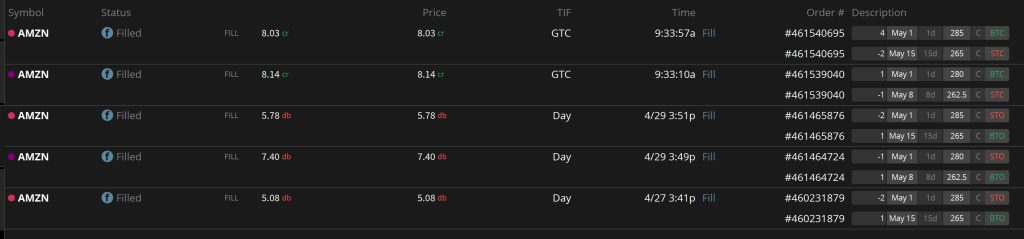
The Actual Execution Log
Based on the transaction history, these positions were built leading up to the announcement and closed immediately following the “crush”.
| Strategy | Date Opened | Entry Cost (Net Debit) | Exit Credit (Net) | Realized Profit |
| AMZN $280 / $262.5 Diagonal | April 29 | $742.25 | $813.74 | +$71.49 |
| AMZN $285 / $265 Diagonal (2 Units) | April 27/29 | $1,092.78 | $1,605.21 | +$512.43 |
| TOTAL | +$583.92 |
The Open: Where the Money Is Made
When the market opens the next morning, everything gets repriced at once. Implied volatility collapses, options premiums drop sharply, and the “uncertainty premium” disappears. This is the volatility crush.
As the records show, these trades were closed within minutes of the opening bell (approx. 9:33 AM). This is when the trade pays—not later after a trend develops. In this case, AMZN pushed higher after the announcement but failed to hold its gains and eventually went red.
The Profit Plateau: Why Movement Stops Paying
Many traders see a stock start to move in their direction and think, “If I stay in, I’ll make more”. But once volatility is crushed, you hit a profit plateau:
- IV has already collapsed, so there is less premium left to decay.
- Directional movement adds very little to the P&L because the options are already significantly cheaper.
- Risk/Reward shifts dramatically, as you are now exposed to directional risk with limited further upside.
The Greeks Behind the Trade
- Vega (Volatility): This did the heavy lifting. When IV collapsed, the short $280 and $285 calls lost value immediately, which is exactly what we wanted.
- Delta (Direction): Played a secondary role. The $285 diagonal performed exceptionally well because the stock stayed below that “ceiling,” allowing those 4 short calls to be bought back for a mere $0.28 each.
- Theta (Time Decay): Acted as a tailwind. With the short legs expiring in just one day, the daily decay was at its absolute maximum.
The Mistake Most Traders Make
Most traders hold too long, turning a high-probability volatility trade into a lower-probability directional gamble. The correct approach is to ask: “Has the edge I entered for already played out?”.
If the answer is yes, the trade is over—regardless of what the stock does next.
A Simple Rule for Earnings Trades
- Enter before earnings to sell the inflated uncertainty.
- Exit at or shortly after the open to capture the crush.
Final Thought
This trade worked exactly as it should have, netting a total profit of $583.92. The volatility was overpriced, the uncertainty resolved, and the premium collapsed. That was the trade. Once you understand that distinction, you stop chasing price and start capturing edge.