

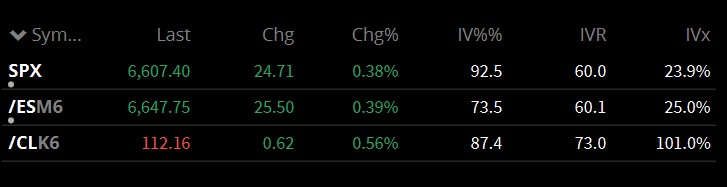
Markets do weird things sometimes. Right now, crude oil (/CL), the VIX, and the S&P 500 (SPX) are all climbing at once. Normally, stocks and volatility move in opposite directions. When the SPX rises, the VIX tends to fall. Oil also typically moves alongside equities on growth expectations. But this combination signals mixed sentiment. Growth looks strong enough to support equities, yet traders are still willing to pay up for protection.
This type of alignment is uncommon. SPX and VIX rise together only about 20 to 25 percent of trading days due to their strong negative correlation, typically in the range of -0.7 to -0.8. When oil is added to the mix, multi-day stretches of all three rising drop below 10 percent. These conditions are usually short-lived and often tied to inflation concerns or geopolitical shocks.
The takeaway is not that a crash is imminent, but that the market may be more fragile than it appears. The rally lacks strong conviction, and eventually one dominant narrative, whether growth, inflation, or fear, tends to take control.
In the past, the U.S. economy was far more dependent on oil imports. Rising oil prices had a more direct and often negative impact on equities. Today, the U.S. is a net oil producer, which changes the relationship. Markets are less sensitive to oil spikes in a macro sense and are more influenced by liquidity, sector rotation, and sentiment.
When has this happened before?
Recent examples include:
- 2026: Oil spiked above $100 on Strait of Hormuz tensions while VIX remained elevated and SPX continued grinding higher
- October 2025: Tariff escalation fears
- Early 2025: Post-tariff volatility with simultaneous oil and SPX gains
- March 2020: COVID-related volatility during reflexive market bounces
These periods typically last only one to five days before the market begins to diverge. Sustained multi-week alignment is rare.
What usually happens next?
| Scenario | Signs | Outcome |
|---|---|---|
| Grind Higher | Steady VIX term structure, firm oil | Choppy SPX advance |
| Vol Spike | VIX curve flattens | Sharp pullback |
| Rotation | Weak SPX breadth | Sector rotation, no crash |
Why oil shocks have less impact on GDP today
Compared to the 1970s, oil shocks now have a much smaller macro impact. Energy intensity per unit of GDP has declined significantly, and the U.S. economy is less dependent on manufacturing and more service-oriented.
| Past Shock | Oil Jump | GDP Hit | Why Milder Today |
|---|---|---|---|
| 1973 Embargo | +200% | -2.5% | Oil-dependent economy |
| 1979 Iran | +150% | -2.1% | High import dependence |
| 2022 Ukraine | +50% | None | Shale production growth |
| 2026 Now | +55% | ~-0.3% | Net energy exporter |
Key reasons include higher efficiency (more GDP per barrel), a services-driven economy where energy is a smaller share of spending, and a Federal Reserve that tends to focus on demand-side inflation rather than supply shocks.
Warnings to watch
- Rally lacking conviction
- Elevated VIX premium relative to realized volatility
- Oil reinforcing inflation concerns
- Short-term hedging flows potentially capping downside
Key indicators include SPX breadth, VIX term structure, credit spreads, yields, and continued oil strength.
Best trades for this environment
This type of market is often favorable for premium-selling strategies. Elevated implied volatility combined with choppy price action creates opportunities for theta-based approaches with defined risk.
Broken Wing Butterfly (BWB)
- Setup: Put BWB with mild bearish bias by buying an in-the-money put, selling two at-the-money puts, and buying a further out-of-the-money put, skipping the downside wing
- Why: Collects premium in sideways or slightly downward markets
- Best used in: SPX, UVXY, /CL options (30 to 45 DTE)
Jade Lizard
- Setup: Short an out-of-the-money put and call, while buying a further out-of-the-money call to remove upside risk
- Why: Neutral to slightly bullish with strong premium collection from elevated volatility
- Best used in: SPX, XLE
111 Trade
- Setup: Bull put spread (30 delta / 16 delta) combined with a short 7 delta put to finance the position
- Why: High probability setup that performs well in choppy markets
- Best used in: /ES futures, SPY, with weekly roll adjustments
Additional approaches
| Trade | Bias | Target | Notes |
|---|---|---|---|
| Put BWB Condor | Mild bear | SPX | 21 DTE range play |
| Call Jade Lizard | Bull theta | Oil ETF | Limited upside risk |
| 111 + 7Δ Short | Bullish | /ES | Bollinger-based exits |
| Iron Condor | Neutral | SPX | Premium harvesting |
Execution guidelines
- Only trade when IVR is above 50 percent to ensure adequate premium
- Reduce position size to about half of normal due to elevated volatility risk
- Consider exits when VIX term structure inverts, credit reaches strong profit thresholds, or market breadth weakens significantly
- Pairing strategies with volatility exposure, such as UVXY PMCC structures, can help balance convexity
Bottom line
This “everything up” environment can persist for weeks, but it is inherently unstable. Selling premium with defined risk, staying disciplined, and focusing on volatility rather than direction tends to be the more reliable approach. Volatility is the real trade, and consistency matters more than prediction. Stay nimble.