
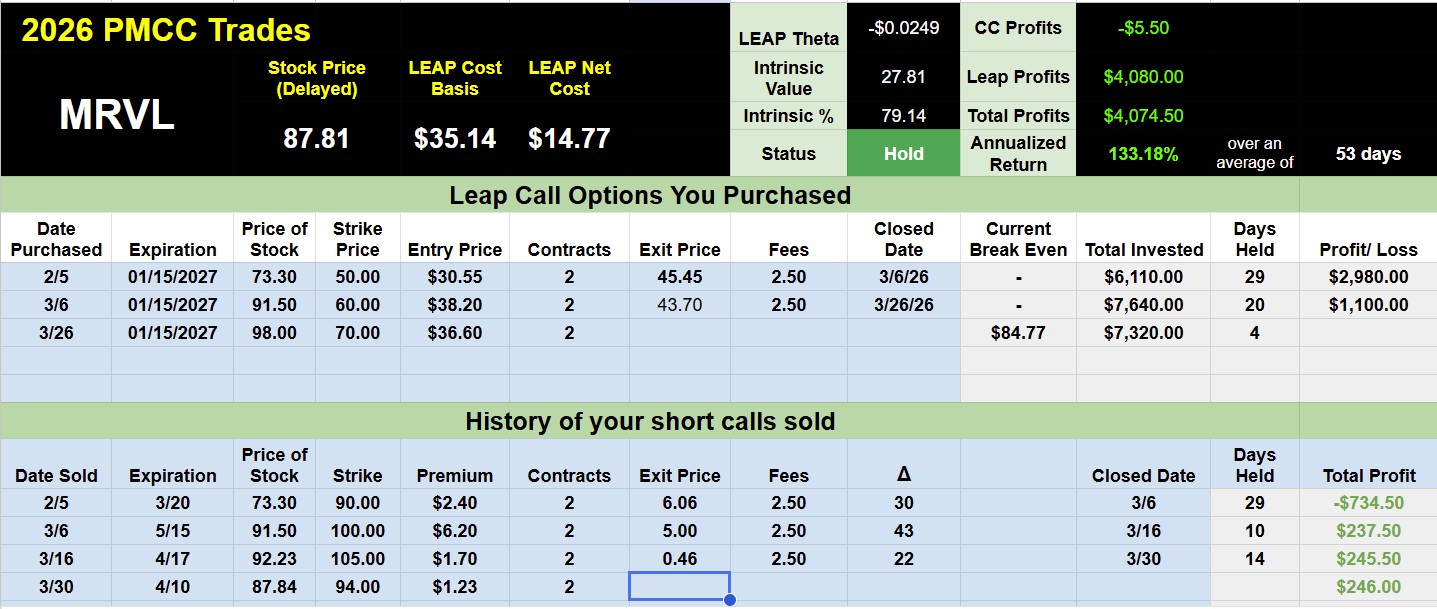
I reviewed my current MRVL PMCC and this trade is a perfect example of how a rules-based system removes emotion and turns decisions into a repeatable process—especially in a high volatility environment.
📊 The Current Position
- MRVL price: ~$87.76
- Short call: Apr 17 $105
- Days to expiration: ~18
- Profit on short call: ~71.8%
- Delta: ~0.19
- LEAP: Jan $70 (deep ITM, ~0.80 delta, ~291 DTE)
At first glance, this position looks very safe. The strike is far away, delta is low, and there’s still time left.
But that’s not how I evaluate it anymore.
🧠 The Only Question That Matters
When running a PMCC as an income system, the key question is:
Has this trade already paid me most of what it’s going to pay?
At ~71.8% profit, the answer is clearly yes.
🔀 The System Decision
My system is simple and strict:
- 50–75% profit → close the trade
No guessing. No debating.
Close the short call and reset the cycle.
⚖️ Why Closing Now Is the Better Trade
Holding for the remaining ~30% sounds appealing, but it comes with tradeoffs:
- Capital is tied up for ~18 more days
- Risk of a sudden move increases
- Daily income efficiency drops
This is where most traders give back edge.
PMCC income is about maximizing premium per unit of time—not squeezing every last dollar out of a trade.
🔥 The Twist: VIX Is 30+ (High Volatility Mode)
Right now volatility is elevated (VIX ~30+), and this changes how I redeploy immediately after closing.
High volatility means:
- Options are expensive
- Expected moves are larger
- I can sell further out and still get paid well
This is the environment where the PMCC system performs best.
🎯 Resetting the Income Engine (High VIX Strategy)
After closing the current call, I don’t wait—I redeploy immediately using my high volatility rules.
🔴 High VIX Setup
- Delta: 15–25
- DTE: 7–14 days
This gives me:
- Faster premium cycles
- High probability trades
- Better income per week
⚙️ What I’m Opening Next
With MRVL around $87–88 and volatility elevated, I’m choosing between two high-quality setups that both fit my system.
🔵 Option A — 18 DTE $95
- Delta: ~0.28
- Theta: ~10.21
- More time, slightly further out of the money
🟢 Option B — 11 DTE $94
- Delta: ~0.26
- Theta: ~15.13
- Shorter duration, faster decay
🧠 How I Made the Decision
Both trades are valid. Both fit my system rules. So the decision comes down to optimization.
The key difference is speed of income.
- The 11 DTE option has significantly higher theta
- It will decay faster
- It will likely reach 50% profit sooner
That means I can:
- Close earlier
- Re-deploy capital faster
- Run more income cycles
⚡ The Trade I’m Taking
Apr 10 $94 (11 DTE, ~0.26 delta)
This aligns best with my system in a high volatility environment:
- Faster premium decay
- Less time risk
- More frequent trade cycles
🔥 The Real Edge
This is the shift that matters:
I’m no longer optimizing for the biggest single trade.
Instead, I’m optimizing for:
- Frequency
- Speed
- Repeatability
In high VIX conditions, shorter-duration trades give me more opportunities to recycle capital and compound income.
🔄 The Execution (What I Actually Did)
After evaluating both options, I executed the roll exactly according to plan.
- Closed: Apr 17 $105 call @ $0.46
- Opened: Apr 10 $94 call @ $1.23
👉 Net credit: ~$0.77
🧠 Why This Matters
This wasn’t just a roll—it was a system-driven reset.
- I locked in gains from the previous trade
- I immediately redeployed into a higher-efficiency position
- I shifted into shorter duration to take advantage of high volatility
Most importantly:
I reduced time and increased income velocity
⚡ What Happens Next
Now the plan is simple and predefined:
- Target 50–60% profit on the new call
- Close early when reached
- Re-sell immediately and repeat the cycle
If price moves toward the strike:
- Prepare to roll before it’s tested
📊 Trade Breakdown (Current Snapshot)
Here’s the current state of the MRVL PMCC system after the latest roll:
- Stock Price: $87.81
- LEAP Net Cost Basis: $14.77
- LEAP Intrinsic Value: $27.81
- Intrinsic %: 79.14%
💰 Performance
- Short Call (CC) Profits: -$5.50
- LEAP Profits: $4,080.00
- Total Profit: $4,074.50
- Annualized Return: 133.18%
- Average Hold Time: 53 days
🔄 Recent Short Call Cycle
- Previous Call: Apr 17 $105
- Sold for $1.70
- Bought back for $0.46
- Profit: ~$245.50
- Current Call: Apr 10 $94
- Sold for $1.23
- Open position (targeting 50–60% profit)
🧠 What This Shows
This breakdown highlights the real power of the system:
- The LEAP provides the core directional profit
- The short calls generate consistent income cycles
- Even when short call profits are small or mixed, the system as a whole compounds effectively
The edge comes from combining direction + income + repetition
❌ What I Avoid (Even in High VIX)
- Selling too close (>30 delta)
- Going too far out (like $105 again)
- Using long DTE (wastes volatility edge)
🧱 The LEAP: Still Doing Its Job
The Jan $70 LEAP remains unchanged:
- Deep ITM
- High delta
- Plenty of time left
It continues to act as my stock replacement and doesn’t need adjustment.
🔁 The Real Edge
This trade shows the full cycle working exactly as designed:
- Sell premium
- Let time decay work
- Close early at 50–75%
- Re-sell immediately based on conditions
High volatility just accelerates this process.
⚡ Final Takeaway
This wasn’t about predicting MRVL—it was about executing a system.
- The trade worked
- The premium was captured
- The environment improved (high VIX)
- The system gave a clear next step
Close the call, redeploy quickly, and let volatility pay you again.
That’s how a PMCC becomes more than a strategy—it becomes a repeatable income machine.