
I don’t really think of what I’m doing with MRVL as a single trade anymore.
It’s a system.
And one of the biggest mindset shifts I’ve had recently is this:
Not every red number is actually a losing trade.
🧾 The Scoreboard (So Far)
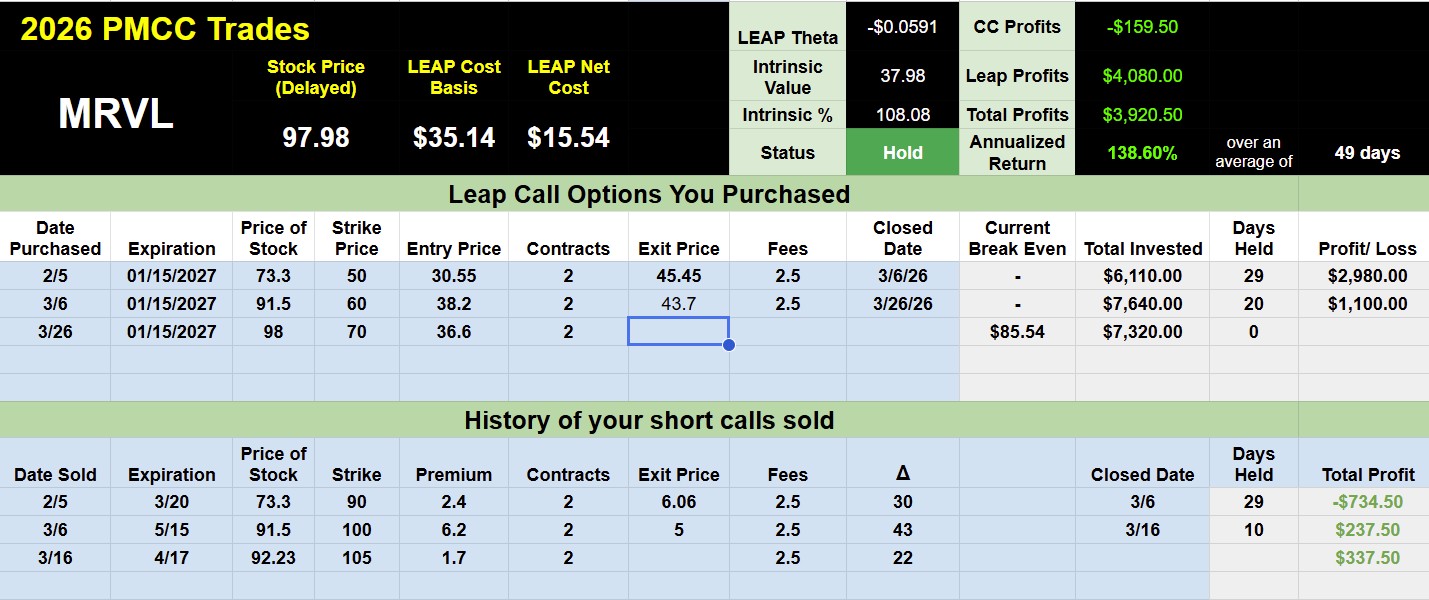
Here’s where things stand:
- Total Profit: $3,920.50
- LEAP Profits: $4,080
- Covered Call Income: -$159.50
- Time in Trade: 49 days
- Annualized Return: ~138%
On paper, it looks like my covered calls are slightly negative.
But that’s not the full story.
🧠 This Was Built, Not Picked
This didn’t come from one perfect entry.
I built this position over time.
My LEAP progression:
- $50 strike → rolled
- $60 strike → rolled
- Now: $70 (Jan 2027)
Most recent move:
- Rolled into the $70 strike for $7.10 debit
- Reset delta to about 0.80
Every roll higher:
- Locked in gains
- Reduced capital risk
- Kept the position efficient
🔴 The “Losing” Covered Call (That Wasn’t)
If you just look at the sheet, you’ll see this:
- First short call cycle: – $734.50
At first glance, that looks like I got run over.
But that’s not what actually happened.
What really happened:
- The stock moved up fast
- My short call lost money
- But my LEAP gained significantly more
- And I rolled the LEAP up at a profit
👉 Net-net, the position improved.
💡 The Real Way to Look at It
This is where I think a lot of people get tripped up.
They evaluate:
- The short call
- The LEAP
- Separately
But with a PMCC, that’s the wrong lens.
It’s one position, not two trades.
So even though:
- The call showed a loss
- The LEAP showed a gain
👉 The system as a whole moved forward.
⚖️ Where I Am Now
Current structure:
- 2x Jan 2027 $70 calls (~0.80 delta)
- 2x Apr $105 short calls
- Stock around $98
Clean, balanced, and efficient.
🔥 Planning for the Drop (Not Just the Rip)
I’ve also started thinking more about the downside.
What happens if MRVL pulls back to $80… or even $70?
🧠 What Actually Happens If It Drops
LEAPs:
- Delta drops
- Value declines
- I give back some gains
But:
👉 I’ve already locked in profits from earlier rolls
Short Calls:
- Expire worthless
- I keep premium
That income starts to matter more in a pullback.
⚠️ The Mistake I Won’t Make
The temptation is:
“I should roll my LEAP down to get more delta again”
I’m not doing that.
Because rolling down:
- Adds capital
- Increases risk
- Often locks in losses
🔄 What I’ll Do Instead
If MRVL drops into the $70–80 range:
1. Leave the LEAP alone
It still has:
- Time
- Recovery potential
2. Sell lower calls
This is where the system works.
- Move strikes closer to price (85–95 range)
- Collect more premium
- Speed up income
3. Let time do its job
The LEAP is the engine.
The short calls are how I:
- Adjust
- Generate income
- Stay flexible
🧠 When I Would Roll Down
Only if I’m making a deliberate shift:
- I think MRVL stays lower long-term
- I want to increase leverage again
And I accept:
- I’m adding risk—not fixing anything
🏁 The Big Takeaway
This is what finally clicked for me:
A PMCC is not about being perfect—it’s about managing the whole structure.
Sometimes:
- The call loses
- The LEAP wins
Sometimes:
- The call wins
- The LEAP drifts
But over time:
👉 The system compounds.
Final Thought
I’m still bullish on MRVL.
But more importantly, I’m confident in the way I’m managing it now.
Because I’ve stopped looking at trades in isolation…
And started thinking in terms of:
Position structure, capital efficiency, and long-term compounding.