

Usually, Wednesday means one thing for my portfolio: the Double Calendar. It’s my bread and butter. But as any disciplined trader knows, the market doesn’t care about your routine—it only cares about the current environment.
Today, that environment required a defensive adjustment.
🌪️ The Setup: High VIX & Fed Risk
When I sat down to look at the SPX this morning, the VIX was up over 5 points, hitting 23 at the time of entry. On top of that, the Fed was scheduled to speak at 2:00 PM.
The concern wasn’t just the price action; it was the Vega risk. Double Calendars are Long Vega, meaning they need volatility to stay stable or rise to remain profitable. With the Fed on deck, there was a real possibility of a massive volatility crush (IV dropping rapidly) after the news hit. I didn’t want to chance a Double Calendar with that kind of IV risk on the table.
🛡️ The Tactical Switch: The Apr 2nd Iron Condor
To avoid the IV trap, I pivoted to a Short Iron Condor expiring April 2nd. By selling the wings in a high-IV environment, I’m using a structure that is Short Vega. If a vol crush happens, it won’t hurt the position—unlike a calendar, which would likely see its long legs bleed value faster than the shorts decay.
📝 The Execution (Exact Fill Prices)
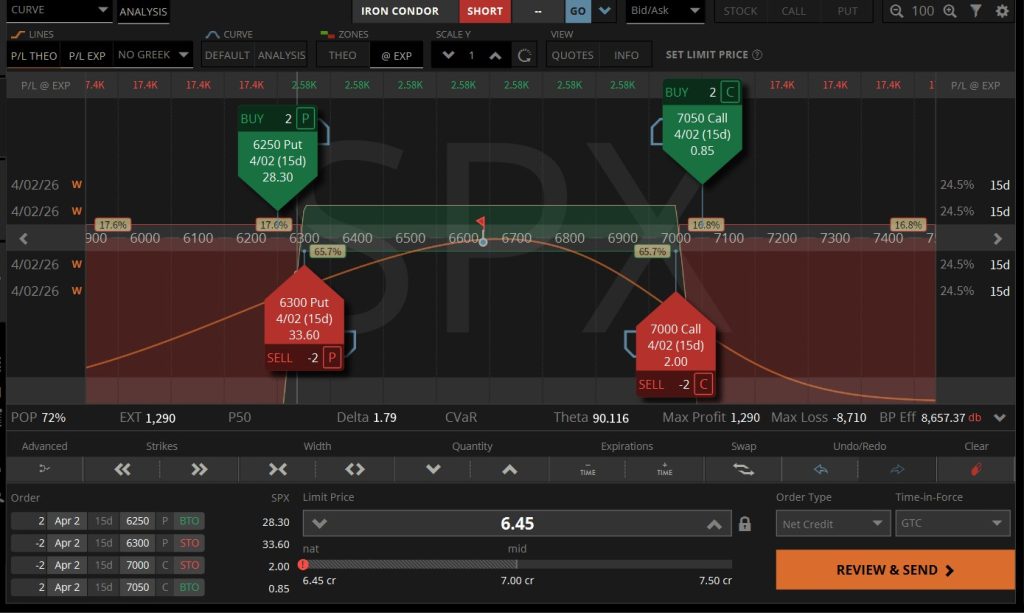
| Side | Action | Strike | Price |
| 🔴 Put Side | SOLD (STO) | 6300 Put | $27.19 |
| 🟢 Put Side | BOUGHT (BTO) | 6250 Put | $22.66 |
| 🔴 Call Side | SOLD (STO) | 7000 Call | $3.24 |
| 🟢 Call Side | BOUGHT (BTO) | 7050 Call | $1.32 |
- Total Net Credit: $6.45 ($645.00 per spread)
🔍 Deep Dive: The Role of Implied Volatility (IV)
The core of this strategy is understanding how Implied Volatility drives profitability:
- High IV as a Driver: IV is the primary driver of Iron Condor profitability. High IV inflates option premiums, allowing us to collect more credit. Selling when VIX was at 23 allowed me to set my strikes at 6300 and 7000—a massive 700-point “safety zone.”
- Insulation from the “Vol Crush”: Iron Condors benefit from a decrease in IV. When premiums shrink due to a vol crush, we can close the position for a profit much faster. By switching from a Calendar, I’m no longer “paying” for volatility that might disappear at 2:00 PM.
- Managing the Risk: While high IV is great for credit, excessive volatility increases the risk of massive price swings breaking the expected range. By widening the wings, I’ve mitigated that risk while keeping the trade Delta Neutral.
- Theta Power: Unlike the calendar, which relies on a specific volatility skew, this trade earns its keep through the steady passage of time (Theta).
🚪 The Exit Strategy: Disciplined Trading
Having a plan is only half the battle. My rules for this trade are set in stone:
- Profit Target: I will be looking to close at 50% profit ($3.22/spread). This allows me to take my chips off the table early and avoid “gamma risk” as we get closer to expiration.
- Stop Loss: If SPX moves aggressively and passes my breakevens, I’m out. No chasing, no “hoping” for a reversal.
🏁 Final Thoughts
Trading isn’t just about following a checklist; it’s about matching the tool to the job. Today, the Double Calendar felt like a liability because of the IV environment. By pivoting to the Iron Condor, I’ve removed the “vol crush” threat and put the statistical edge back in my favor.
Leave a Reply