

The market is staging a solid recovery today, and Marvell Technology (MRVL) is right in the thick of it. With the stock currently trading around $92.14—up approximately 5%—it’s essentially a leveraged version of the broader tech bounce.
While it’s great to see the green on the screen, a 5% move in a single session puts immediate pressure on the “short” side of my PMCC. To keep the trade balanced and avoid getting capped too early, I went to work on the spreadsheet today to roll my strikes.
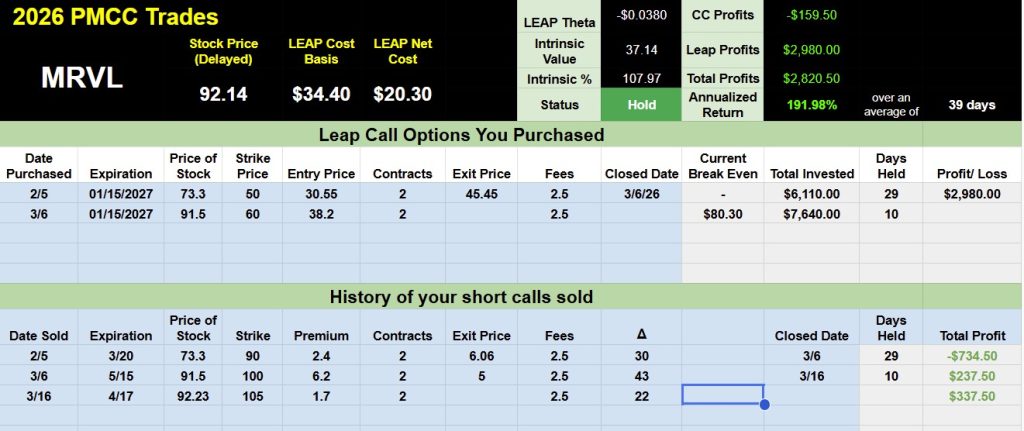
The Execution: Rolling the 100s to 105s
The goal of a PMCC is to let your LEAPS do the heavy lifting while collecting “rent” via short calls. When the stock jumps 5%, that rent can get expensive to buy back. Fortunately, the timing worked out to close for a profit before the delta expanded too far.
The Numbers:
- Exit: I closed my 5/15 $100 calls (originally sold on 3/6 for $6.20) for an exit price of $5.00.
- The Win: Despite the stock’s run-up, I walked away with a $237.50 profit on those two contracts in just 10 days of decay.
- The New Position: I rolled into the 4/17 $105 calls, collecting a $1.70 premium.
Why Roll Now?
By moving the strike from 100 to 105, I’m giving the stock an extra $5 of “headroom.” In a market that is aggressively rebounding, you don’t want your upside capped at a level the stock might hit by lunchtime tomorrow.
Moving to the 105s allows me to:
- Protect the LEAP upside: My $60 strike LEAPS (purchased 3/6) are deep in the money. I want them to capture as much of this recovery as possible.
- Reset the Delta: My new short calls have a Delta of 22, which is much more comfortable than the 43 Delta I was seeing on the 100s as they got challenged.
Dashboard Check: 191.98% Annualized
Even with the volatility of the last few weeks, the strategy is proving its resilience. My total realized and unrealized profit currently sits at $2,820.50.
With an average hold time of 39 days, the tracker is showing a 191.98% annualized return. It’s a reminder that even when the stock is just “moving with the market,” consistent strike management is what actually turns those market moves into realized gains.
Leave a Reply