

Trade Performance Summary
| Metric | Details |
| Strategy | SPX $30\Delta$ Double Calendar |
| Trade Duration | 7 Trading Days (Feb 23 – Mar 2) |
| Entry Net Debit | $6,597.00 |
| Exit Net Credit | $7,650.00 |
| Total Net Profit | $1,053.00 (After Fees) |
| Return on Risk | 15.9% |
Closing Statement
I’ve officially closed out this SPX Double Calendar today, March 2nd, walking away with a significant win after a seven-day hold.
When I entered this position on Monday, February 23rd, the goal was to capitalize on the accelerating theta decay of the standard weekly cycle while maintaining a neutral-to-rangebound delta. Despite the typical Monday-to-Monday market fluctuations, the index stayed well within my profit tent, allowing time decay to do the heavy lifting. By staying disciplined with my exit targets, I was able to capture the move and secure a 15.9% return on risk.
The Trade Math:
- Initial Entry (Feb 23): I entered for a net debit of $6,597.00.
- The Exit (Mar 2): I closed the entire spread for a net credit of $7,650.00.
- Total Net Profit: $1,053.00 (after all fees/commissions).
By closing today, I’ve captured a 15.9% return on the capital risked ($1,053 profit on $6,597 debit).
While I could have held these for another day or two to squeeze out more decay, the front-month (March 10) options were starting to pick up gamma risk. With over $1,000 in the bank and a healthy ROI, I’m more than happy to take my chips off the table and look for the next setup. This trade is a great example of why I love the “Opportunistic Monday” entries—get in, let time work for you, and get out before the Greeks get messy.
Trade Overview

This was not my standard Wednesday deployment.
I entered this 30Δ double calendar on Monday after SPX was down approximately 1% on the day. The downside move provided an opportunity to enter the structure with slightly elevated short-term volatility and expanded premium.
- Underlying: SPX
- Price at Entry: ~6,883
- Day Context: SPX down ~1% intraday
- VIX at Entry: ~20
- Regime Classification: Transitional / Pullback
- Structure: 15 DTE shorts / 30 DTE longs
- Strike Selection: ~30Δ on both sides
Term Structure at Entry
- Front Month IV (15 DTE): 20.2%
- Back Month IV (30 DTE): 20.9%
- Curve Condition: Contango
- Interpretation: Mild upward-sloping term structure supportive of calendar structures.
- IV Differential (Back – Front): +0.7%
Trade Construction
Short Legs (15 DTE)
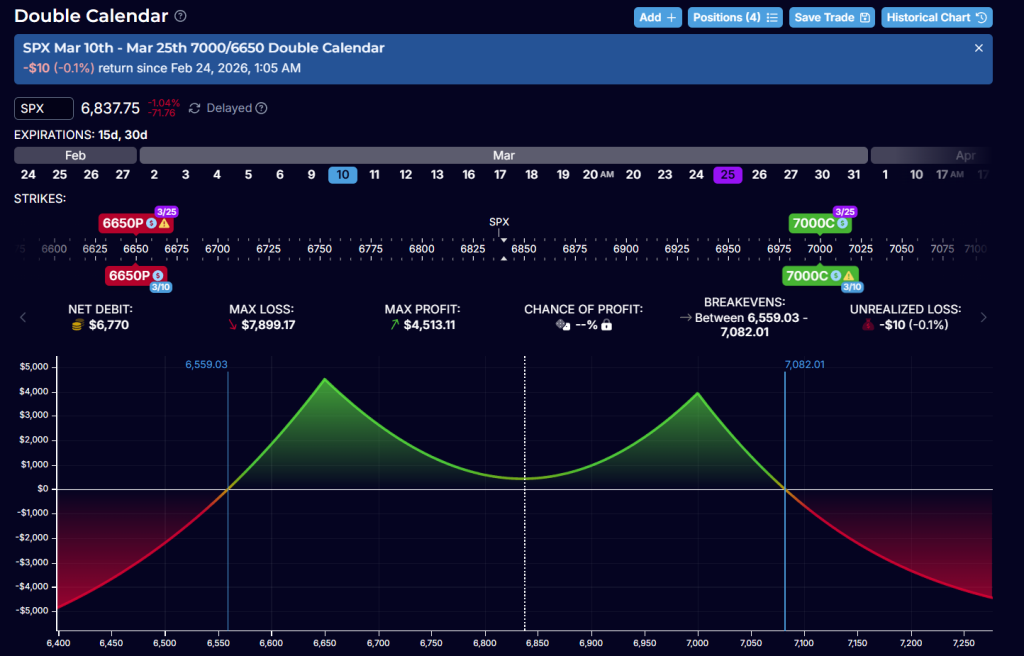
- Short 6650 Put
- Short 7000 Call
Long Legs (30 DTE)
- Long 6650 Put
- Long 7000 Call
- Total Debit Paid: ~ $6,900
- Buying Power Used: Defined-risk debit position
Execution Screenshot

Risk Profile at Entry
- Max Profit (theoretical): Centered between short strikes
- Max Loss (theoretical): Limited to total debit paid
- Breakeven Range: Outside short strikes
- Width Between Shorts: 350 points
- Structure Width (% of underlying): ~5%
This structure was entered into short-term weakness, positioning for mean reversion or stabilization.
Structural Assessment
Volatility Context
The 1% down move elevated near-term implied volatility modestly while maintaining contango in the curve. This supports the calendar structure by:
- Allowing richer short premium
- Maintaining back-month support
- Preserving positive vega exposure
Price Context
- Distance to short put: ~3.4% below entry
- Distance to short call: ~1.7% above entry
- Entry taken during downside pressure
The thesis is that sharp single-day moves often stabilize mid-week, allowing theta capture.
Greek Posture at Entry
- Net Delta: Slightly bullish bias due to down-day entry
- Net Vega: Positive
- Net Theta: Modest positive mid-cycle
- Gamma Risk: Low at entry, increases as front month decays
Trade Plan
- Take Profit: 10% of debit
- Stop Loss: 25% of debit
- Maximum Hold: 13 calendar days
- Exit Style: Mechanical
- No Rolling. No Adjustments. All legs closed simultaneously.
Expected Behavior
This trade performs best if:
- SPX stabilizes after the 1% down day
- Volatility normalizes or expands moderately
- Price remains contained within 6650–7000
It underperforms if downside momentum accelerates or volatility compresses rapidly.
Leave a Reply