
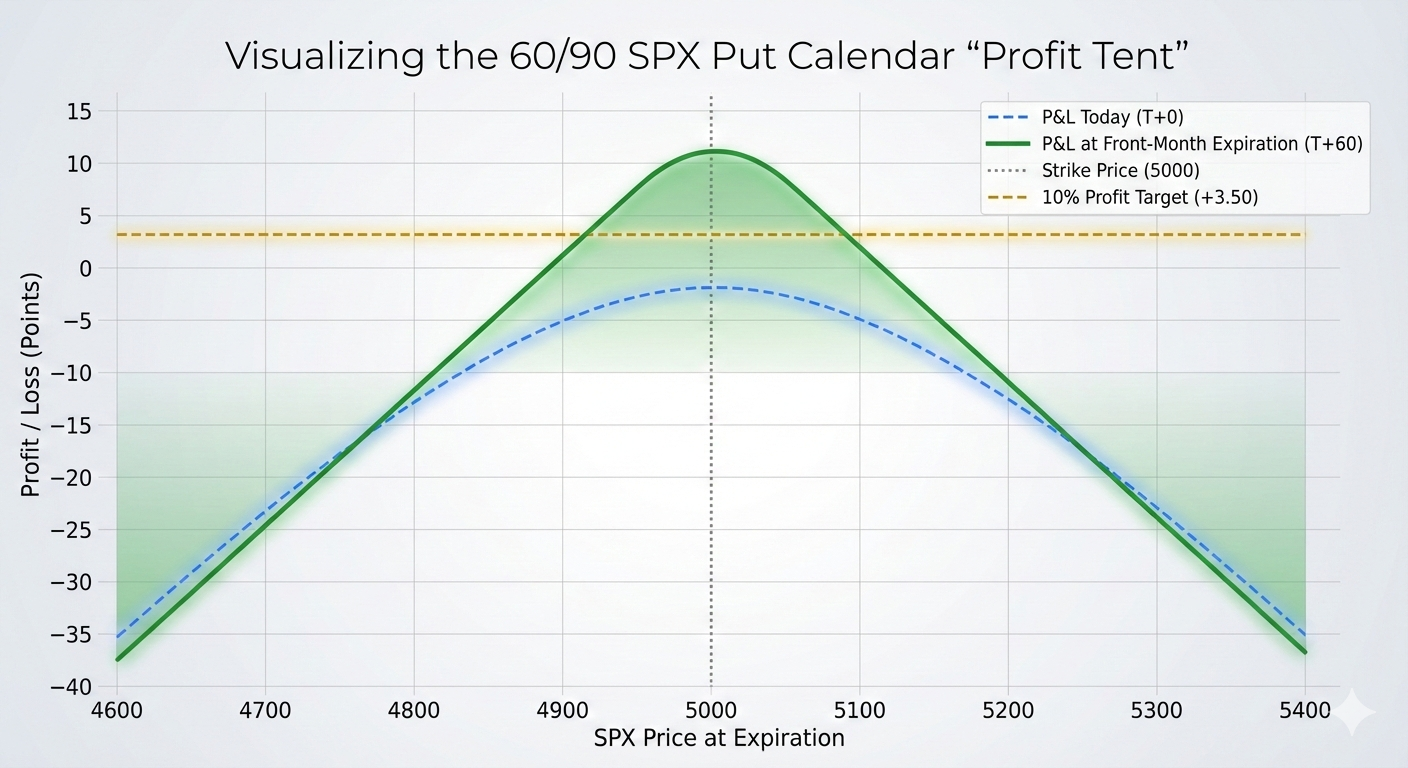
📘 The 60/90 Calendar System
Status: Active
Asset Class: SPX (Primary), IWM, AAPL
Strategy Type: Non‑Directional Income
Trader Archetype: The Volatility Merchant
🧭 One-Page System Summary (Read Before Every Trade)
🔧 Trade Construction (Non-Negotiable)
| Component | Rule |
|---|---|
| Structure | 1× Short ~60 DTE / 1× Long ~90 DTE calendar |
| Strike | Closest to 50 Delta (intentional skew, not true ATM) |
| Option Type | Indexes: Puts preferred · Equities: Calls or Puts |
| Entry Timing | Monday @ 12:00 PM ET only |
| Trade Type | Net debit, long vega, neutral bias |
🎯 Entry Checklist (All Must Be True)
| Check | Requirement |
|---|---|
| IV Rank | < 30 |
| Theta | Front-month theta > Back-month theta |
| Term Structure | Flat or Contango (Back ≥ Front IV) |
| Earnings (Not relevant to SPX) | None within 14 days (single stocks) |
If any item fails → No trade.
📈 Management Rules
| Rule | Action |
|---|---|
| Profit Target | +10% to +15% of debit |
| Hard Stop | -20% of debit |
| Adjustments | None required; rolls are optional and logged |
This is a base-hit system. Do not optimize past the edge.
⏱️ Exit Rules (Mandatory)
| Trigger | Action |
|---|---|
| Time Exit | 15 DTE @ 3:00 PM ET — take it as priced |
| Early Exit | Profit target or hard stop hit |
Never hold inside 15 DTE.
🧠 Behavioral Rules
| Rule | Reminder |
|---|---|
| No Discretion | The system replaces judgment |
| No Prediction | You rent time, not direction |
| No Hero Trades | Capital preservation > recovery stories |
If you feel the urge to “wait one more day,” you are already violating the system.
🌬️ The Philosophy: Selling Shelter, Not Direction
You are not a gambler guessing which way the market will blow.
You are a merchant selling shelter to those who fear the storm.
| Gambler | Volatility Merchant |
|---|---|
| Bets on direction | Bets on time & fear |
| Needs to be right | Needs patience |
| One outcome | Many paths to profit |
The edge: Markets consistently overestimate speed (IV) and underestimate time (theta). Calendars monetize that mismatch.
🏗️ I. Building the Tent: Trade Construction
This section defines the entire mechanical construction of the trade. If it is not specified here, it is not discretionary.
This is a long-vega, theta-positive, neutral-bias calendar spread designed to monetize time decay and volatility mispricing.
1️⃣ Strategy Structure
| Leg | Action | Quantity | Expiration |
|---|---|---|---|
| Short Leg | SELL | 1× | ~60 DTE |
| Long Leg | BUY | 1× | ~90 DTE |
• Same strike
• Same option type (Call or Put — see rules below)
• Net debit trade
You are selling fast decay to finance slow decay.
2️⃣ Strike Selection (Intentional Skew)
Select the option closest to 50 Delta at entry
This is an intentional design choice.
| Reason | Benefit |
|---|---|
| Skew Capture | Exploits volatility skew (especially in index puts) |
| Vega Efficiency | Higher vega per unit of debit |
| Probability Balance | ~50/50 directional exposure |
| Structural Consistency | Normalizes entries across regimes |
• Delta drift after entry is expected
• Strikes are not adjusted to re-center delta
3️⃣ Option Type Selection
| Asset Class | Default Choice | Rationale |
|---|---|---|
| Indexes (SPX, NDX, RUT) | Puts | Persistent downside skew |
| ETFs / Equities | Calls or Puts | Based on skew & earnings |
No automatic weekly alternation. Option type selection is structural, not calendar-based.
4️⃣ Expiration Selection (The 60/90 Rule)
| Component | Target |
|---|---|
| Front Month | Closest to ~60 DTE |
| Back Month | Closest to ~90 DTE |
This spacing:
- Maximizes theta differential
- Preserves long-vega exposure
- Avoids early gamma dominance
5️⃣ Entry Timing (Mandatory)
Open all new positions on Mondays at 12:00 PM ET
| Reason | Edge |
|---|---|
| Weekend Risk Priced | Eliminates gap uncertainty |
| Volatility Stabilized | Avoids open-related IV noise |
| Liquidity Improved | Tighter spreads |
| Backtest Integrity | Consistent data sampling |
No early entries. No late-week entries. No discretion.
—-|——-|————|
| Short Leg | SELL 1× option | ~60 DTE |
| Long Leg | BUY 1× option | ~90 DTE |
• Same strike
• Same option type
• Net debit trade
🎯 II. Strike Selection (Intentional Skew)
This system intentionally uses ~50 Delta — not true price-based ATM.
This is a design choice, not an approximation.
The Rule
Select the option closest to 50 Delta at entry
This will usually be near ATM, but not always exactly at the spot price.
Why 50 Delta Matters
| Benefit | Explanation |
|---|---|
| Skew Capture | 50-delta options embed volatility skew more efficiently |
| Vega Efficiency | Higher vega per dollar than strict ATM |
| Probability Balance | ~50/50 directional probability keeps the trade neutral |
| Structural Consistency | Delta-based selection normalizes entries across regimes |
Using delta rather than spot price ensures the calendar is built on probability and volatility, not just price coincidence.
Important:
- Delta will drift after entry — this is expected
- We do not rebalance strikes to maintain 50 delta
🔁 III. Calls vs Puts — Do We Alternate Weekly?
Short Answer: No automatic alternation.
Calendars are volatility trades, not directional bets. The option type should be selected based on skew and structure, not the calendar week.
Preferred Logic
| Asset Type | Preference | Reason |
|---|---|---|
| Indexes (SPX, NDX, RUT) | Puts | Downside skew is persistently overpriced |
| Equities / ETFs | Calls or Puts | Depends on skew & earnings |
Optional Rotation (Advanced)
Alternating can be used only if:
- Both sides show similar IV rank
- No earnings or macro distortions
- You want delta neutrality across a portfolio
⚠️ This is portfolio‑level balancing, not a system rule.
🧭 IV. The 60/90 Timeline Rule
| Component | Target |
|---|---|
| Front Month | Closest to ~60 DTE |
| Back Month | Closest to ~90 DTE |
This spacing:
- Creates a strong theta differential
- Preserves long-vega exposure
- Avoids early gamma dominance
🕛 V. Entry Timing: Why Every Monday at 12:00 PM (ET)
All new calendar positions are opened on Mondays at 12:00 PM Eastern.
This is a system rule, not a convenience.
The Rule
Open new 60/90 calendars only on Mondays at 12:00 PM ET
No early entries. No late-week adjustments. No discretionary timing.
Why This Timing Creates Edge
| Reason | Explanation |
|---|---|
| Weekend Risk Removed | Weekend gaps and news are already priced in by Monday midday |
| Opening Volatility Settles | Monday morning order-flow noise has largely normalized |
| Cleaner IV Read | Implied volatility stabilizes after the first trading hours |
| Gamma Reset | Short-dated gamma distortions from prior week have rolled off |
| Consistent Data | Backtests assume uniform entry timing — this preserves validity |
Entering at noon avoids:
- The emotional volatility of the open
- The thin liquidity of early trading
- The skew distortions caused by overnight futures movement
Why Not Later in the Week?
| Day | Problem for Calendars |
|---|---|
| Tuesday–Wednesday | Inconsistent DTE spacing and rolling gamma effects |
| Thursday–Friday | Accelerating front-leg gamma and distorted theta |
Calendars reward structure and repetition. Monday midday provides both.
———|——-|
| Front Month | Closest to 60 DTE |
| Back Month | Closest to 90 DTE |
This spacing:
- Creates a strong theta differential
- Preserves long‑vega exposure
- Avoids early gamma dominance
🧱 V. The Three Pillars of the Edge
All three must align. No exceptions.
1️⃣ Theta Differential (Daily Rent)
✔ Front‑month theta meaningfully greater than back‑month theta
You must collect more decay than you pay.
2️⃣ Volatility Bias (Long Vega)
| Rule | Threshold |
|---|---|
| IV Rank | < 30 |
Low IV gives room for expansion. Calendars entered in high IV suffer from vega compression.
3️⃣ Term Structure (Critical)
Ideal: Back‑month IV ≥ Front‑month IV (flat or contango)
| Structure | Action |
|---|---|
| Flat / Contango | ✅ Trade |
| Backwardation | ❌ Stand down |
Selling short‑term fear during panic destroys the calendar edge.
📜 VI. Trade Rules (Non‑Negotiable)
| Rule | Value |
|---|---|
| Position Size | 2–5% of BPR |
| Profit Target | +10% to +15% debit |
| Hard Stop | -20% debit (see rationale below) |
| Time Exit | 15 DTE @ 3:00 PM ET (front leg) — take it as priced |
This is a base‑hit system, not a home‑run strategy.
⏱️ VII. Why the 15‑DTE Exit Matters
| Risk | Explanation |
|---|---|
| Gamma Acceleration | Around 18–15 DTE, gamma begins to dominate theta |
| Overnight Gap Risk | One overnight move can erase weeks of gains |
| Liquidity Distortion | Late-day and expiration-adjacent pricing becomes noisy |
Why 3:00 PM ET Matters
Exiting at 3:00 PM ET avoids the closing auction, where:
- Bid/ask spreads widen
- Market-on-close orders distort option pricing
- Dealer hedging artificially inflates gamma and IV
At 3:00 PM, pricing still reflects true optionality, not end-of-day mechanics.
“Take It As Priced”
This removes discretion:
- No waiting for a bounce
- No limit fishing
- No interpreting the chart
You accept the market’s final fair price for this risk.
Professionals leave early. Gamblers stay.
🛑 VIII. Risk Control: Why the -20% Hard Stop
The -20% hard stop is a design constraint, not a comfort choice.
Why Not 30–40%?
| Factor | -20% Stop | 30–40% Stop |
|---|---|---|
| Tent Integrity | Preserved | Often structurally broken |
| Recovery Odds | High | Low without IV spike |
| Capital Efficiency | Fast redeploy | Capital trapped |
| Behavioral Risk | Controlled | Hope-driven |
Calendar losses accelerate when price moves faster than theta can compensate. Beyond ~20% drawdown, the tent is usually collapsed, not merely dented.
Structural Logic
- Calendars are slow, convex trades
- Large losses usually occur from price displacement, not time decay
- Once displaced, the trade requires:
- Price reversal and
- Volatility expansion and
- Time — all at once
That combination is statistically rare.
System Advantage
By exiting early:
- You preserve mental capital
- You avoid gamma-driven cascades
- You redeploy into fresh 60/90 structures with intact edge
This system wins by avoiding deep holes, not climbing out of them.
⚠️ IX. Known Traps
☠️ The Gamma Cliff
Never hold inside 15 DTE.
🎭 The Earnings Mirage
| Asset | Rule |
|---|---|
| Single Stocks | No calendars <14 days pre‑earnings |
IV crush hits the long leg harder than the short can compensate.
🧨 Assignment Risk
| Instrument | Risk |
|---|---|
| SPX | None (cash‑settled) |
| SPY / IWM / AAPL | Early assignment |
Prefer SPX whenever possible.
🧠 IX. Advanced Variations
🌾 Double Calendars (“The Barn”)
| Feature | Benefit |
|---|---|
| Put + Call Calendar | Wider profit valley |
| Higher cost | Smoother P/L |
Best for range‑bound environments.
📊 Volatility Regimes
| VIX | Action |
|---|---|
| 12–18 | Ideal |
| 18–25 | Smaller size |
| >25 | Switch strategies |
Calendars need time. Panic markets move too fast.
🧾 X. Trader Workflow
Trade Log (Execution)
- Entry tent screenshot
- Debit, IV Rank, strikes
- Rolls documented in same log
Trail Log (Mindset)
- Emotional reactions
- Rule adherence
- Lessons learned
Skill is built after the trade, not during it.
🏁 Final Thought
This system does not predict markets.
It rents time from impatience.
Follow the structure, respect volatility, and let boredom compound profits.